
On this page
In Brief
Joged bumbung is a Balinese social dance for entertainment, performed by one or more women to a gamelan of bamboo instruments called grantang. During the dance the dancer invites a man from the audience, with a touch of her fan or sash, to dance with her; his steps are improvised, and it is considered impolite to refuse. It is thought to have begun in Buleleng, north Bali, in the 1940s, as a dance farmers made up to relax after work, and Tempo, citing the culture ministry, names the village of Kalopaksa in Seririt district. In 2015 UNESCO inscribed "three genres of traditional dance in Bali" on its list of intangible heritage; Joged Bumbung is one of the nine dances in that listing, represented by a group from Jembrana regency. Competition between troupes pushed some performances toward erotic display, known as joged jaruh, and Bali's government has pushed back, most firmly in October 2024 with a governor's circular and an official standard for the dance from the Bali Cultural Council.
Joged Bumbung at a Glance
- What it is: a secular social dance (tari pergaulan) in which the dancer invites audience members to dance
- The music: gamelan joged bumbung, also called gerantangan, built around bamboo xylophones (grantang, or tingklik in central Bali)
- Origin: Buleleng, north Bali, in the 1940s, among farmers resting after work
- When it is danced: weddings, after the harvest, holy days and village celebrations
- The partner: the pengibing, the man from the audience who dances with her
- UNESCO: one of nine dances in "Three genres of traditional dance in Bali", inscribed 2015, listed under Jembrana
- The rules today: a governor's circular and an official standard from the Bali Cultural Council, both of October 2024, ban joged jaruh
How the Dance Works
Joged belongs to celebrations, with no role in temple ritual; it is danced for fun at weddings, after the harvest, on holy days and at village festivals. A woman, or several, dances in a cleared space in front of the orchestra. The Bali provincial government describes her costume as simple: a length of songket or gold-printed prada cloth, a kebaya, a flowered headdress, a sash, and a fan.
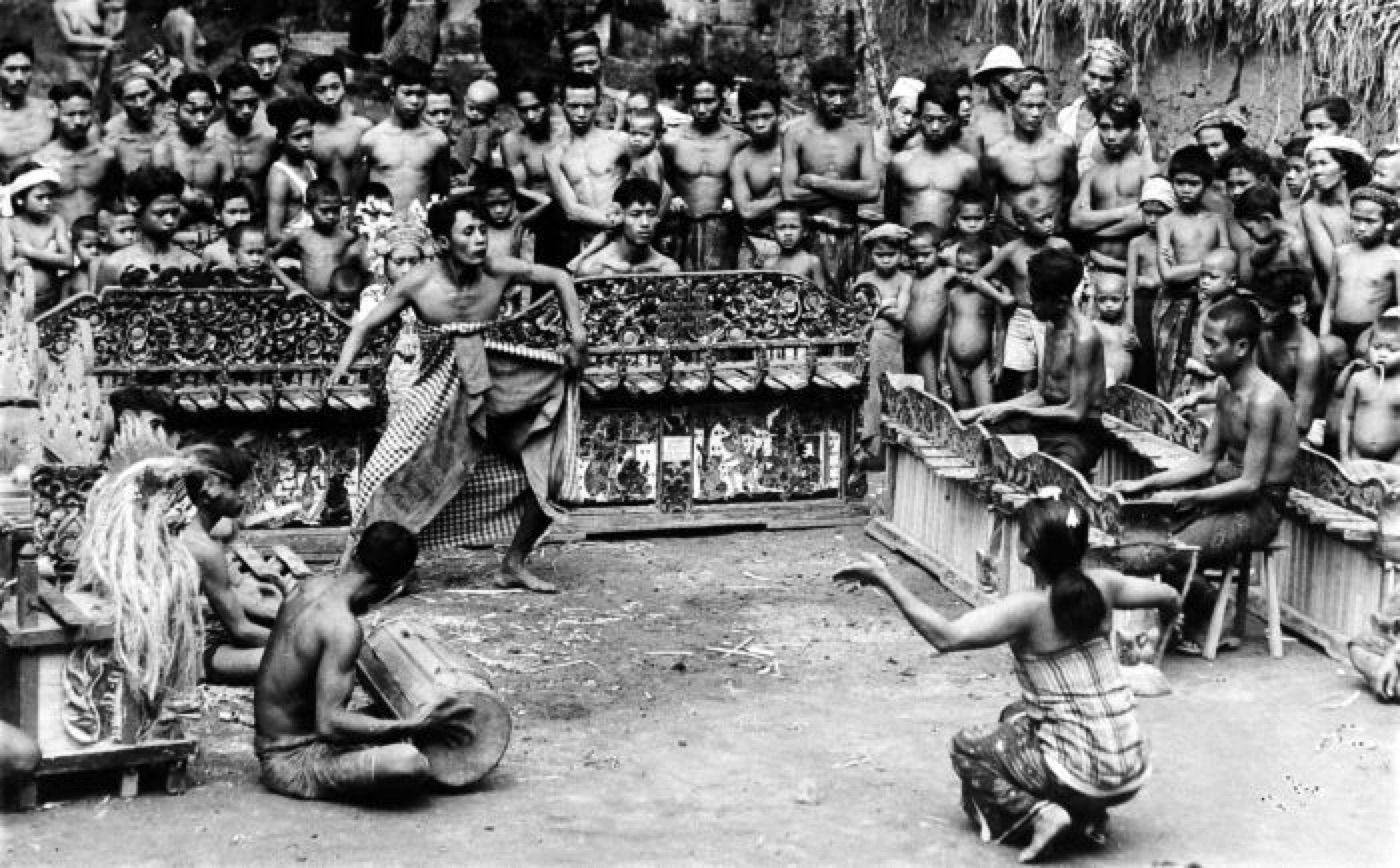 A joged dancer and her partner before a village crowd, with the gamelan behind them, Bali, around 1935. Photo: Unknown author, Tropenmuseum / Wikimedia Commons (CC BY-SA 3.0)
The heart of it is the invitation. The dancer picks out a man from the crowd with a touch of her fan or sash. He comes out and dances with her, improvising; there are no set steps for him, and it is considered impolite to refuse. The partner is called the pengibing. The exchanges between the two, in Wikipedia's summary, range from humorous to teasing.
It is one of a family of joged dances. An older form, joged pingitan, is danced to the rindik, the bamboo xylophone tuned to slendro, as the guide to Balinese gamelan explains. Joged bumbung shares its name with its orchestra, the gamelan joged bumbung, and in the Balinese sorting of dance into sacred, semi-sacred and entertainment forms it sits firmly in the third, balih-balihan, the dances for an audience (see Balinese dance and gong kebyar).
The Bamboo Orchestra
The gamelan joged bumbung is made mostly of bamboo. Its main instrument, the grantang, is a bamboo xylophone of eleven to fourteen tubes, each cane split halfway down and carved so that the unsplit half forms a closed resonator. The keys are struck with rubber-tipped mallets called panggul, which give a dry, short sound. The left hand plays the melody in the low register while the right plays a faster, decorated version; when the decoration is too fast for one player, two players split it between them in interlocking parts, the kotekan that drives all Balinese gamelan.
 A rindik, the bamboo xylophone. Photo: William Cho / Wikimedia Commons (CC BY-SA 2.0)

A typical ensemble has four to six grantang, with bamboo flutes (suling), a drum (kendang), small cymbals (ceng-ceng), a beat-keeper of bamboo or bronze, gongs and a large bass bamboo. Most joged ensembles are tuned to the five-note slendro scale, though in northern and western Bali pelog tunings are more common. The style is especially popular in the north and west. How kotekan and the paired tunings work is covered in Balinese gamelan.
Where It Began: Buleleng in the 1940s
The sources agree on the north. Indonesian Wikipedia's account places the dance's origin in Buleleng in the 1940s, as a social dance that farmers made up to entertain themselves while resting from work. Tempo, citing the Bali office of the culture ministry, names the village: Kalopaksa, in Seririt district, west of Lovina, where farmers danced to the bamboo tingklik in their free time. From there it spread across the island as village troupes, sekaa, took it up.
The north keeps it on stage. At the Buleleng Festival in Singaraja, the stages at the Catus Pata crossroads belong to folk performance, joged among them; see the Buleleng Festival guide. For the town of Seririt and the countryside around it, see Seririt.
The UNESCO Listing, Under Jembrana
In 2015 UNESCO inscribed three genres of traditional dance in Bali on its Representative List of the Intangible Cultural Heritage of Humanity. The nomination picked nine representative dances, three for each genre, and tied each to a regency. Joged Bumbung is one of the three entertainment dances, listed in the nomination file as "Joged Bumbung (Jembrana District), a popular social dance by couples, during harvest season or important days". The community group named for it is Joged Bumbung Winangun Semara, of Mendoyo Dangin Tukad village in Jembrana. The other two entertainment dances are Legong Kraton and Barong Ket.
So the listing credits Jembrana, in the far west, while the dance's history is traced to Buleleng. The nomination tied each dance to one regency and one community group, and the grantang style is at home across both the north and the west. Buleleng's own dance in the listing is Wayang Wong of Tejakula; see Tejakula village.
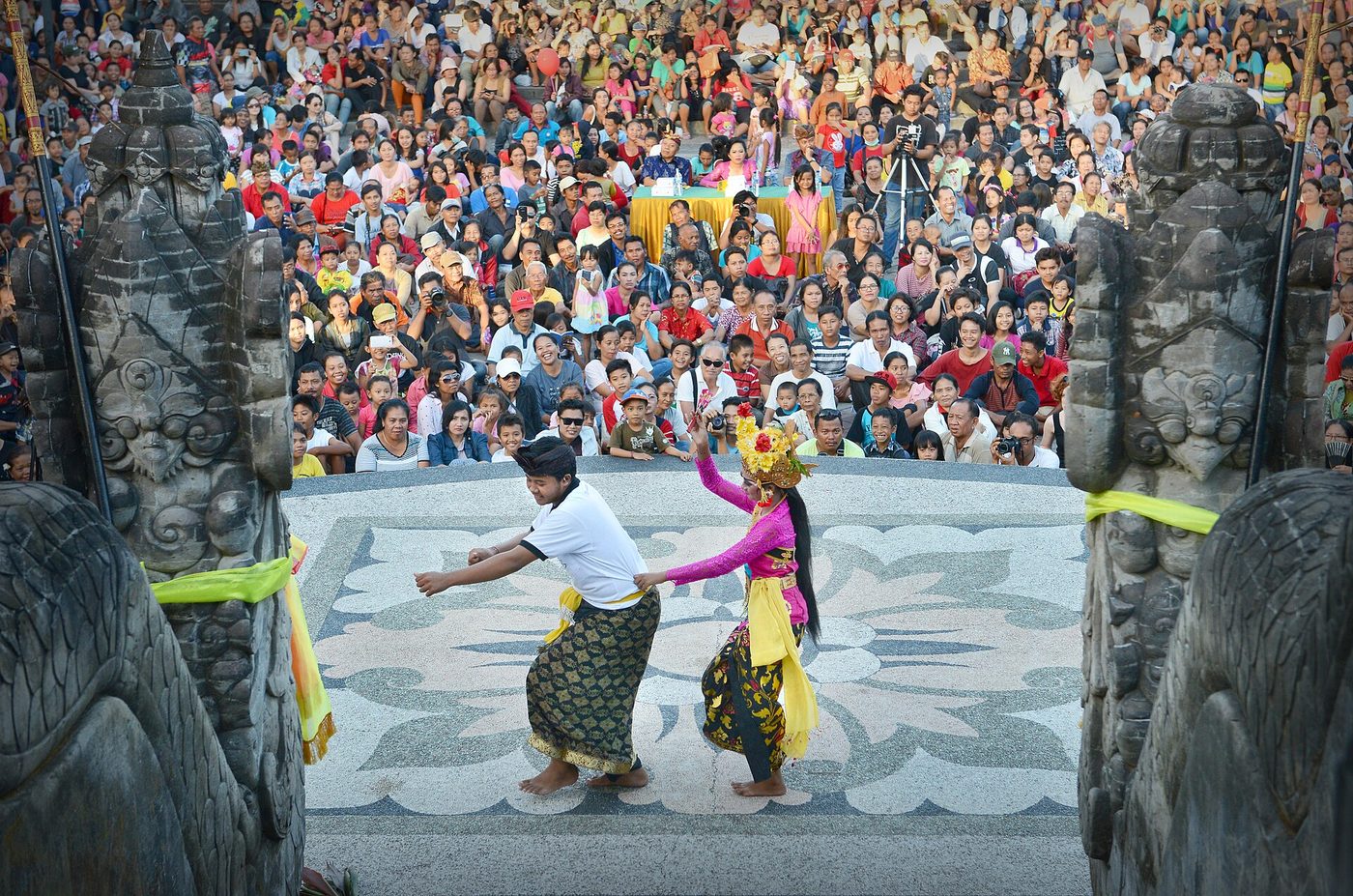 Joged Bumbung, the dancer and a volunteer partner, before a village crowd. Photo: Manik Agung / Wikimedia Commons (CC BY-SA 4.0)

"Joged Jaruh" and the Campaign Against It
The flirtation built into joged made it easy to push further. Competition between troupes, Indonesian Wikipedia and Tempo both note, led some to add suggestive hip movements and to pull partners into erotic routines, a style that came to be called joged jaruh, "dirty joged", and circulated widely in videos online. Other troupes kept to the classical form.
In 2016 the governor, Made Mangku Pastika, told ANTARA he would issue a circular to the regents, the mayor and the council of customary villages to act against pornographic joged, and asked village heads, customary leaders and the village guards, the pecalang, to stop such performances in their areas. "There shouldn't be any porno joged; it shames us," he said. His culture office urged each customary village to write a ban into its own perarem, its written customary agreement, and planned a joged festival for the following year to show the dance done properly. How those village rules work is in the Balinese village and the banjar, and the village guards in pecalang.
The rules have since been made precise. On 21 October 2024 the Majelis Kebudayaan Bali, the Bali Cultural Council, issued an ilikita, an official standard, for joged bumbung, No. 01/X/MKB/2024, signed by Prof. I Made Bandem as the council's Saba Pemutus. The next day Bali's acting governor issued Circular No. 18 of 2024 on the traditional dance Joged Bumbung Jaruh. Together they set the form of the performance and the costume, and ban joged jaruh across Bali, on stage, at public events and on social media. The provincial government says the erotic versions break the Balinese principles of siwam, satyam, sundaram, holiness, truth and beauty, and that it will work with the council to stop performances and remove videos.
The head of Bali's culture office, I Gede Arya Sugiartha, told ANTARA that earlier circulars had been ignored because they had no standard attached saying what was allowed. The new rules bind dance groups, dancers, pengibing, event organisers and social media users. Violators are not taken to court; they are called in, given guidance and asked to sign a statement.
Seeing Joged Bumbung
Joged is danced where people celebrate: at weddings, village festivals, holy days and the regency festivals. In the north, the Buleleng Festival in August puts joged on its folk stages, and village celebrations around Lovina and Seririt may include a troupe; ask your hosts. If you are invited to dance, it is polite to accept; keep it good-humoured and follow the dancer's lead, since the October 2024 rules apply to partners too. For the rest of the north's music and dance, start with Balinese dance and gong kebyar and Balinese culture.
Seririt and Kalopaksa lie a short drive west of Lovina, where most of Palm Living's villas are.
FAQ
What is joged bumbung? A Balinese social dance performed by a woman to a gamelan of bamboo xylophones. During the dance she invites men from the audience to dance with her, and their steps are improvised. It is danced for entertainment at weddings, festivals and after the harvest.
Where does joged bumbung come from? It is thought to have begun in Buleleng, north Bali, in the 1940s, among farmers relaxing after work. Tempo, citing the culture ministry, names the village of Kalopaksa in Seririt district.
Is joged bumbung a UNESCO heritage dance? Yes. It is one of the nine dances in "Three genres of traditional dance in Bali", inscribed by UNESCO in 2015, where it is listed under Jembrana regency as an entertainment dance.
What instruments accompany joged bumbung? The gamelan joged bumbung, an orchestra built around the grantang, a bamboo xylophone, with bamboo flutes, a drum, small cymbals, gongs and a large bass bamboo instrument.
What is joged jaruh? Jaruh means dirty or obscene. Joged jaruh is the name for erotic versions of the dance that spread through competition between troupes and online videos. Bali's government banned it in October 2024, with a governor's circular and an official standard from the Bali Cultural Council.
Can tourists join in a joged dance? Yes, if the dancer invites you; it is considered impolite to refuse. Keep it good-humoured and follow the dancer's lead.
Sources
- UNESCO, nomination file for Three genres of traditional dance in Bali, for the nine dances, Joged Bumbung under Jembrana and the community group, read September 2026 (in English)
- UNESCO Intangible Cultural Heritage, Three genres of traditional dance in Bali, inscribed 2015, read September 2026 (in English)
- Bali Provincial Government, Bali bans joged bumbung jaruh after the Cultural Council issues its ilikita, November 2024, for the circular, the ilikita, the costume and the ban, read September 2026 (in Indonesian)
- ANTARA, Bali issues rules for joged bumbung, for I Gede Arya Sugiartha's account of the rules, read September 2026 (in Indonesian)
- ANTARA, Governor of Bali bans erotic joged bumbung, 2016, and Province urges villages to write perarem against porno joged, for the 2016 campaign, read September 2026 (in Indonesian)
- Tempo, The origins of joged bumbung, for Kalopaksa in Seririt and the rise of joged jaruh, read September 2026 (in Indonesian)
- Wikipedia, Gamelan joged bumbung, Joged dance and Joged Bumbung, for the instruments and tuning, the invitation to dance and the Buleleng origin, read September 2026 (in English and Indonesian)
Read next: Balinese dance and gong kebyar, Balinese gamelan and the Buleleng Festival.