
On this page
In Brief
Kembar buncing is the Balinese term for boy-girl twins. Under the custom called manak salah, "wrong birth", a commoner family who had them was held to have polluted the village: parents and babies were moved out of their house to the graveyard or a crossroads for 42 days, and the parents had to pay for a costly purification of the village. Twins born to a royal family, by contrast, were celebrated as a sign of prosperity. On 12 July 1951 Bali's regional legislature (DPRD) abolished the custom in Decision No. 10 of 1951, declaring that parents of buncing twins are guilty of nothing and may not be punished. What remains today is uneven. Padangbulia, a customary village in Sukasada district of Buleleng, still asks such families to spend three lunar months in a hut at the edge of the village, paid for, guarded and fed by the whole village, while other villages mark the birth only with a period of ritual impurity and a purification ceremony.
Kembar Buncing at a Glance
- Kembar buncing: twins of opposite sex, a boy and a girl
- Manak salah: "wrong birth", the custom that treated such a birth among commoners as a source of impurity for the village
- Old practice: family moved to the graveyard or a crossroads for 42 days, then a village purification (prayascita) at their expense
- In royal families: a good omen, marked with feasts
- Abolished: 12 July 1951, Decision No. 10 of 1951 of the Bali DPRD, often cited as Regional Regulation No. 10 of 1951
- Still practised in a changed form: Desa Adat Padangbulia, Sukasada, Buleleng, north Bali
- The Padangbulia version: three tilem (new moons), about three months, in a hut at the village edge, with the village paying and keeping watch
- Texts cited by the village: the lontar Dewa Tatwa and Brahma Sapa, among others
Palace and House: Why Twins Were Treated Two Ways
The custom only makes sense beside its opposite. When The Jakarta Post reported a buncing birth in 2012, it set out the old contrast. Twins born to a royal family were an auspicious event, celebrated with public feasts; in the old stories they were married to each other when grown and ruled together, and a kingdom ruled by them was thought blessed with prosperity and victory. Twins born to commoners were manak salah, a wrong birth, and the family and babies were sent out of the village until a purification ritual, in some cases to makeshift shelters in the cemetery.
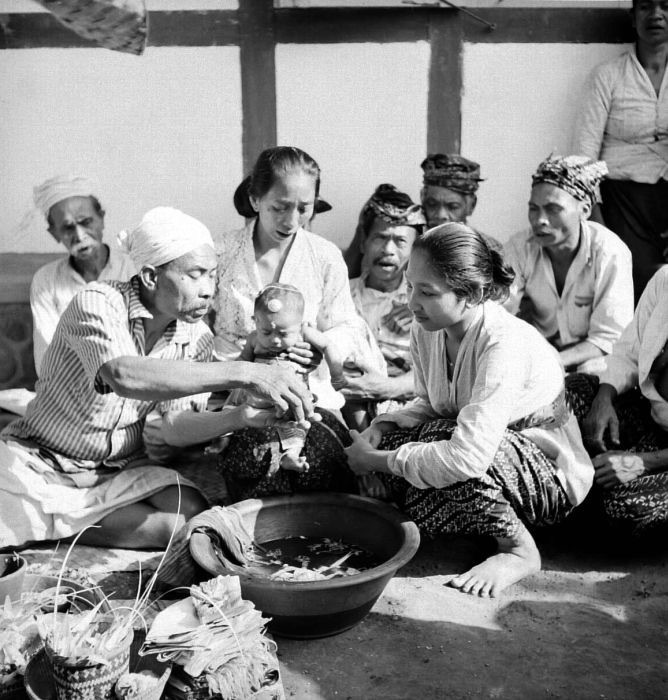 A baby's three-month ceremony, photographed in 1949. Photo: Unknown author, Tropenmuseum / Wikimedia Commons (CC BY-SA 3.0)

The 1951 decision itself gives the reason in its preamble. The rule, it says, applied only to the sudra caste, under an old idea that giving birth to boy-girl twins imitated the king and brought trouble on the land. I Wayan Windia, a professor of Balinese customary law at Udayana University, told The Jakarta Post that the concept could not be traced to any valid Balinese Hindu text, and that social status, rather than any divine principle, lay behind it: imitating royalty was a grave offence in old Bali, and buncing twins were treated as a royal privilege.
The village that still keeps a form of the rite disagrees about the texts. Padangbulia's leaders cite palm-leaf manuscripts, the lontar Dewa Tatwa and Brahma Sapa, as the basis for its purification. A study by three Warmadewa University law researchers quotes a passage from the Dewa Tatwa listing the unusual births that leave a village's temples impure: people born without limbs or eyes, with more or fewer body parts than usual, boy-girl twins, and any imperfect birth, including among animals.
The 1951 Abolition
Bali abolished manak salah in the first years of the republic. On 12 July 1951 the Bali DPRD issued Decision No. 10 of 1951, a paswara on "the abolition of the custom called manak salah". Later writers call it Regional Regulation No. 10 of 1951; the Balinese law writers at BaleBengong give it as Keputusan DPRD Bali Nomor 10/1951.
Its preamble, as quoted in the Warmadewa study, lists three objections. The baby and its parents had to be moved from their home to the graveyard or a crossroads for 42 days, which offended both humanity and health. The parents then had to hold a prayascita purification for the village at great cost. And the custom no longer suited the times. The decision then rules, in three short articles:
- Anyone who gives birth to a boy and a girl, once called manak salah or buncing under Balinese Hindu custom, is no longer considered guilty and may not be given any punishment.
- The custom called manak salah or buncing is abolished.
- The regulation takes effect on the day it is announced.
A decree is one thing and a village's law is another. BaleBengong lists banishment near the graveyard or outside the village for manak salah as the example of a customary sanction officially banned by the authorities, while noting that customary law in Bali changes through each village's own awig-awig. How those village codes work is in the Balinese village and the banjar.
Padangbulia: The Village That Keeps the Rite
Padangbulia is a customary village in Sukasada district, just south of Singaraja. Here, when boy-girl twins are born, the family reports the birth to the village head, the kulkul drum is sounded, and villagers build a hut for the family at the tanggun desa, the edge of the village, or by a campuhan, a meeting of streams.
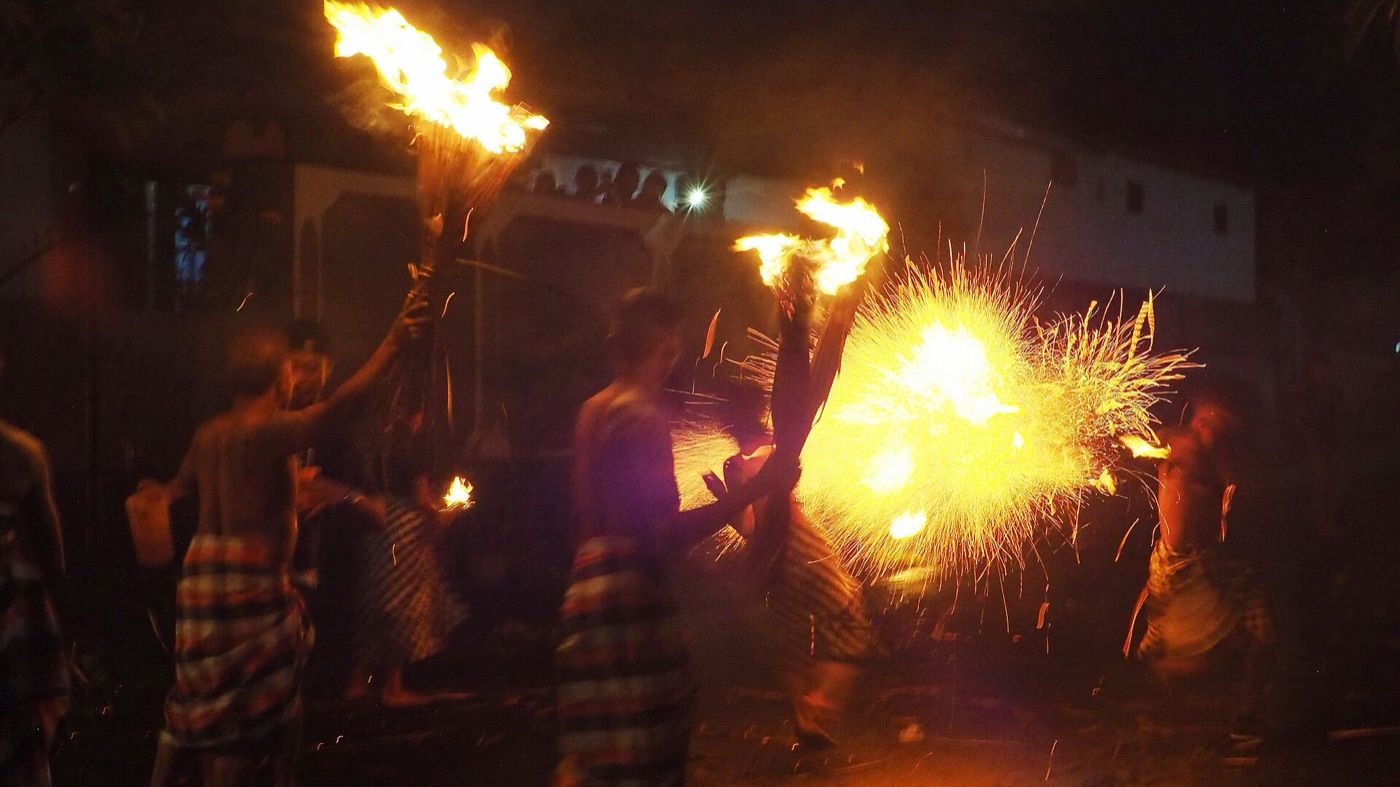 Padangbulia's men at meamuk-amukan api, the fire fight the village holds the day before Nyepi. Photo: Kardian Narayana / Wikimedia Commons (CC BY-SA 4.0)
NusaBali reported the case of I Gede Sadia Utama and Ni Made Welianingsih, whose buncing twins were born by caesarean in hospital. The family went straight from the hospital to the hut without setting foot in their own yard. Villagers had furnished it with a bed, electricity, a bathroom and a kitchen, and built an open platform outside where men of the village took turns keeping watch at night. The rule was three tilem, three new moons, about three months, with the village cooking their meals and paying for the mother's and babies' health checks. The father kept his job and returned to the hut after work.
While the family is at the hut the whole village is sebel, ritually impure. The village head, I Gusti Komang Suparta, told NusaBali that all rites of the temples stop for those three months. Deaths and baby ceremonies still go ahead, kept as simple as possible, and holy water is asked for from a distance rather than inside the temple. The period closes with a great caru offering and a melasti purification at the sea, after which the family goes home. What a caru is and why it is made is in mecaru.
The village insists this is care, not exile. "This is not banishment," Suparta said; the family is served and guarded by everyone, and the village pays for it all. Padangbulia's reading, as the Warmadewa study puts it, is that the 1951 decision does not cover what it does: the decision spoke of sudra families, while Padangbulia applies the rite to every family whatever its caste; it spoke of graveyards, while Padangbulia's huts stand far from the cemetery; and it spoke of costs charged to the parents, while Padangbulia pays. Sadia Utama told the researchers he was not forced and felt he was served like a king. A June 2024 study in the journal Sebatik describes the same practice as the village's open resistance to the 1951 rule, and notes that some villagers resist the rule more quietly, in talk among themselves rather than in the open.
What Remains Elsewhere
In most of Bali the banishment has gone, though the idea of impurity has not everywhere. In 2012 the customary village of Ketewel in Gianyar declared a 42-day impurity after brother-and-sister twins were born to a gynaecologist's family, and kept its temples empty through Galungan and Kuningan, allowing each family only a simple offering at home. Ketewel did not send the family away, and the village paid for the closing purification. Galungan's place in the calendar is explained in Galungan and Kuningan.
The ordinary rites of a Balinese childhood, from the three-month ceremony to the first otonan, and the birth-order names every child receives (see Balinese names), are the frame against which the buncing rite stood out.
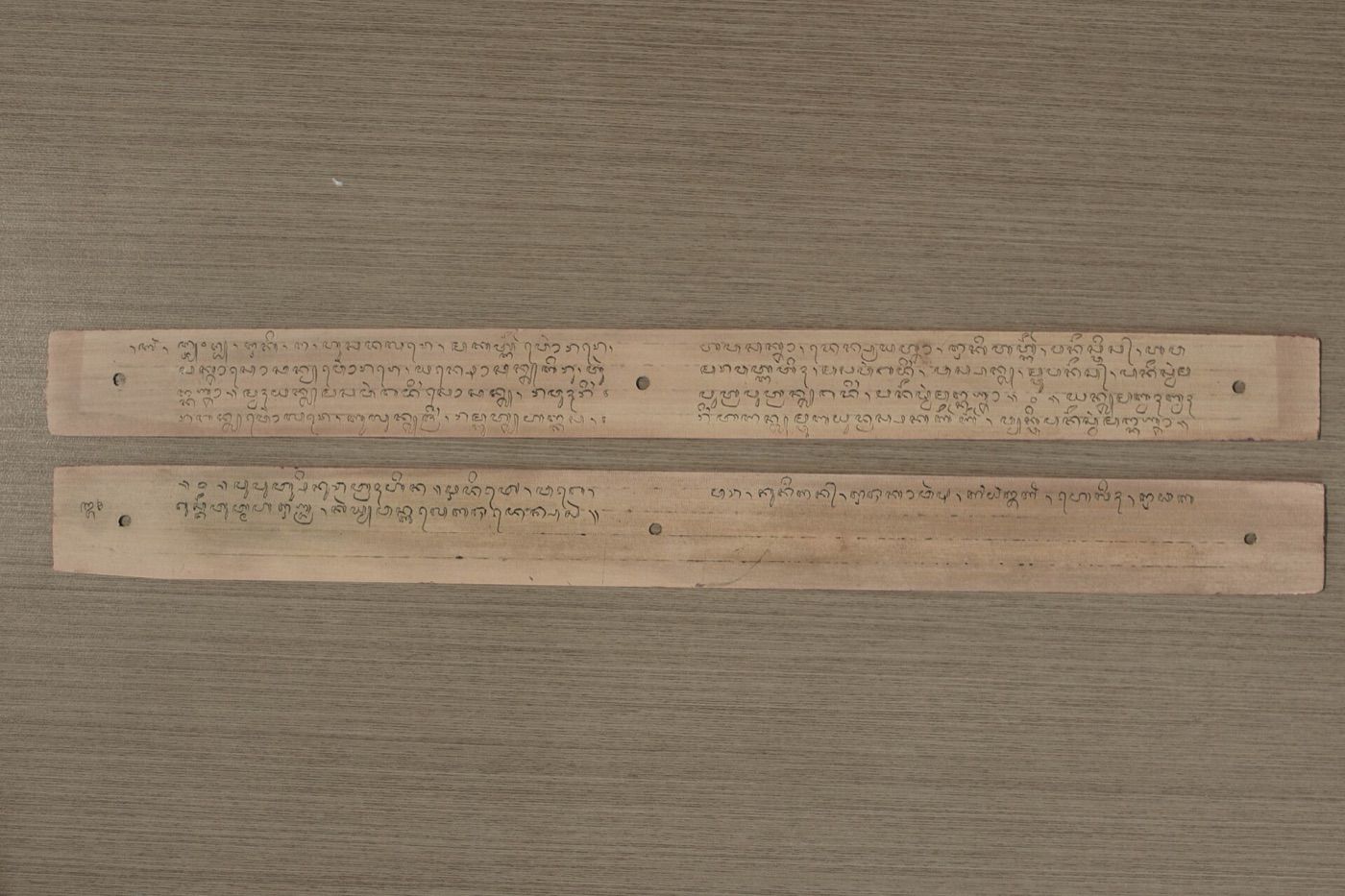 Lontar, Balinese palm-leaf manuscripts, at the Balai Bahasa Bali. Padangbulia bases its rite on texts of this kind. Photo: Eka343 / Wikimedia Commons (CC BY-SA 4.0)

Reading the Custom Today
For a visitor this is a story to understand, never a sight to go and look for. The hut at Padangbulia is a family's home for three months during a sacred period, and the village is in a state of impurity; it is no place for curiosity. The wider frame, the seen and unseen worlds that purity rites address, is in sekala and niskala, and the island's ritual cycle is in Balinese ceremonies and the Balinese culture hub.
Padangbulia sits above Singaraja, a short drive from Lovina, where most of Palm Living's villas are. The village is known too for its fire fight the day before Nyepi; the island's new year rites are in Nyepi, the day of silence.
FAQ
What does kembar buncing mean? Kembar buncing is Balinese for twins of opposite sex, a boy and a girl born together. Kembar means twins; buncing refers to the pairing of a male and a female.
What is manak salah in Bali? Manak salah, "wrong birth", was the custom of treating the birth of boy-girl twins to a commoner family as a source of impurity for the village. The family was moved to the graveyard or a crossroads for 42 days and had to pay for the village's purification.
When was manak salah abolished? On 12 July 1951, when Bali's regional legislature issued Decision No. 10 of 1951, often cited as Regional Regulation No. 10 of 1951. It declared that parents of buncing twins are guilty of nothing, may not be punished, and that the custom is abolished.
Is manak salah still practised in Bali? In a changed form, in the customary village of Padangbulia in Buleleng, north Bali, where the family of buncing twins spends three lunar months in a hut at the village edge, cared for and paid for by the village, followed by a purification. Some other villages, such as Ketewel in Gianyar in 2012, have declared a period of ritual impurity without sending the family away.
Why were royal buncing twins treated differently? Twins born to a royal family were taken as a good omen and celebrated. The law scholar I Wayan Windia has argued that social status explains the difference: a commoner family with buncing twins was seen as imitating royalty, a serious offence in old Bali.
Are twins bad luck in Bali? The old taboo concerned only boy-girl twins, and only in commoner families; royal buncing twins were taken as a blessing. Bali's legislature abolished the custom in 1951, though The Jakarta Post noted in 2012 that several villages still observed a form of it.
Sources
- Ni Luh Gede Astari Dewi, I Ketut Sukadana and Diah Gayatri Sudibya, Tradisi manak salah di Desa Adat Padangbulia, Jurnal Konstruksi Hukum, Warmadewa University, January 2021, for the text of the 1951 decision, the lontar, and the village's reading of the rule, read September 2026 (in Indonesian)
- Rahmat Sewa Suraya, Komang Wahyu Rustiani and I Ketut Suardika, Padangbulia people's resistance to Public Policy No. 10 of 1951, Sebatik, June 2024, for the stages of the rite and the village's resistance, read September 2026 (in English)
- NusaBali, Families with buncing twins stay at the village edge for three months, for the Sadia Utama case, the hut, the village's care and Suparta's account, read September 2026 (in Indonesian)
- The Jakarta Post, Rituals called off after birth of twins, February 2012, for Ketewel, royal twins, Padangbulia in 2004 and I Wayan Windia, read September 2026 (in English)
- BaleBengong, Customary sanctions in Bali, including those no longer in force, for the DPRD decision of 12 July 1951 and the list of abolished sanctions, read September 2026 (in Indonesian)
- Wikimedia Commons, Meamuk-amukan api, Padang Bulia, the photographer's description of the village's fire fight before Nyepi, read September 2026 (in Indonesian)
Read next: Otonan, the Balinese birthday, mecaru and the Balinese village and the banjar.