
On this page
- In Brief
- Ngayah at a Glance
- Ngayah Means Service Without Wages, Offered Upward
- Ngayah and Gotong Royong Share a Spirit, Not a Direction
- The Teaching Behind It Is Karma Marga, Work as Worship
- For Village Members, Ngayah Is Also a Duty
- What Ngayah Looks Like, from Bamboo to Gamelan
- Ngayah Brings Neighbours Together, and Office Hours Test It
- How to Behave Around Ngayah as a Guest
- FAQ
- Sources
In Brief
Ngayah is the Balinese tradition of working without pay for the temple and the customary village. A Balinese-Indonesian dictionary gives its literal meaning as doing work without wages. In Balinese Hindu teaching it is service offered to God, an act of karma marga, the path of selfless action.
Ngayah is carried out in the spirit of gotong royong, Indonesia's ethos of working together. Balinese writers still set it apart from nguopin, the help relatives give one another at a family ceremony. Nguopin runs between people. Ngayah is directed upward, to God, the temple and the village.
For members of a customary village, ngayah is also a duty set in the village's own rules. You see it in the days of preparation before a temple festival, a cremation or another big ceremony.
Ngayah at a Glance
- Literal meaning: Doing work without wages
- Root word: Ayah, service, with ayahan, pengayah (the one who serves) and ngayahang
- The teaching: Karma marga, selfless action offered to God
- Given to: The temple, the banjar and, in the past, the palace (puri) and the priest's house (gerya)
- Who gives it: The member households of a customary village, its youth groups and its arts groups
- Typical work: Offerings, bamboo work, decorating and cleaning temple grounds, gamelan and sacred dance
- Its neighbour: Nguopin, help between relatives at a family ceremony
- In law: Bali's 2019 regulation on customary villages names ayah-ayahan, physical work, as a duty of full members
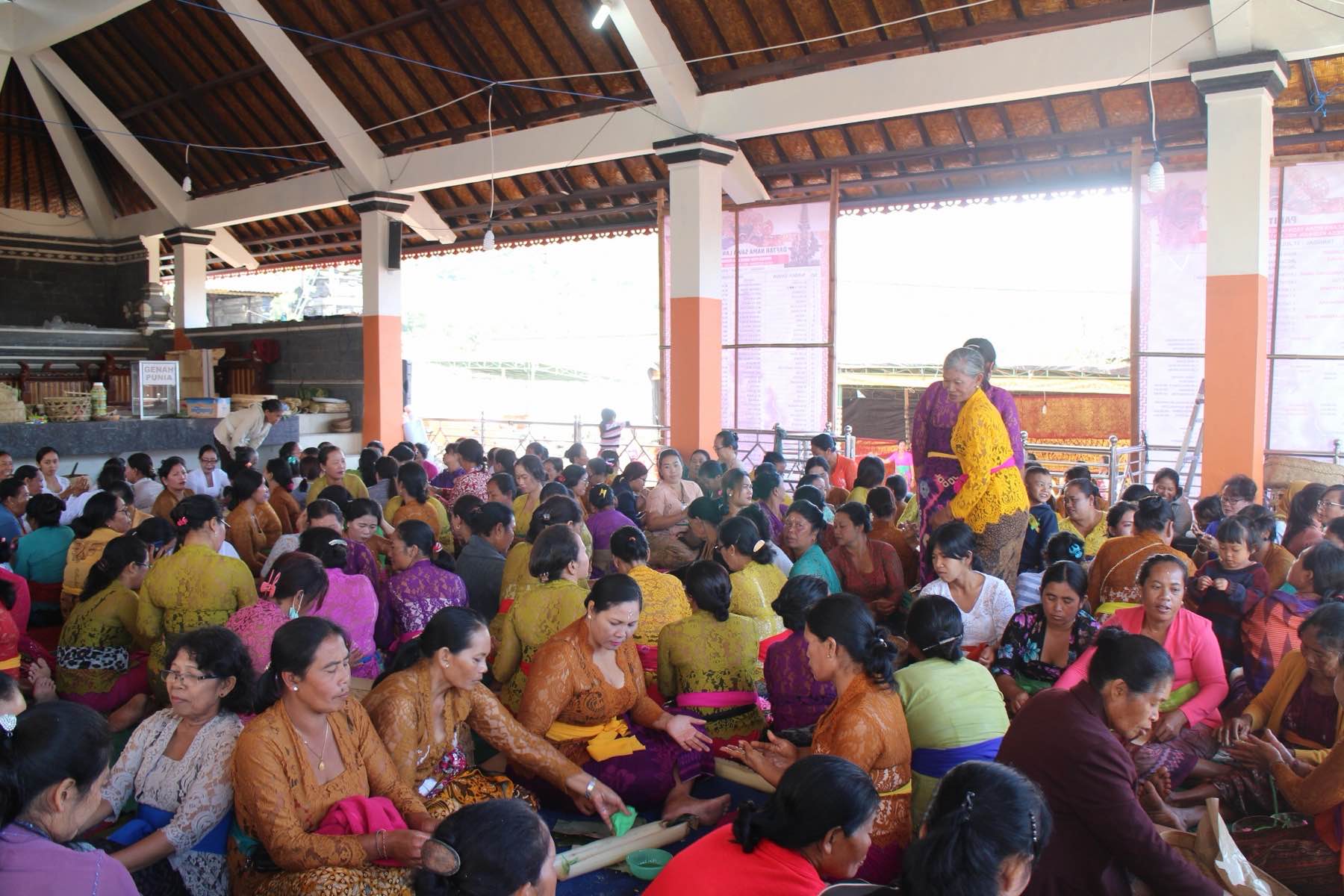 Women gathered for ngayah, preparing a customary ceremony in Bali. Photo: Michaelparikesit / Wikimedia Commons (CC BY-SA 4.0)
Ngayah Means Service Without Wages, Offered Upward
The word comes from ayah, Balinese for service.
I Wayan Sudarma, a Hindu religious counsellor in Bangli, sets out its history for the Ministry of Religious Affairs. He cites the 1990 Balinese-Indonesian dictionary for the literal meaning, work done without wages. The word took shape in the age of Bali's kings, around tanah ayahan desa, village land whose occupants owed duties in return.
He lists three kinds of duty tied to that land:
- Pengayah pura: service to the temples, above all the three village temples, the Kahyangan Tiga
- Pengayah banjar: service to the customary neighbourhood and its social life
- Pengayah puri: loyalty and service to the ruling king, since some ayahan land was a royal gift
So Balinese speak of ngayah ke pura, ngayah ke banjar and ngayah ke puri or ke gerya. The phrase ngaturang ayah, offering one's service, carries the same idea.
Suka Ardiyasa, a lecturer who lives in Singaraja, defines the pengayah in tatkala.co. A pengayah serves without asking anything back, dedicated in full to the Creator. The essay's title is a rhyme on the word: ngayah is not lelah sing mabayah, "tiring and unpaid".
Ngayah and Gotong Royong Share a Spirit, Not a Direction
Gotong royong is the wider idea, shared across Indonesia.
The phrase means "joint bearing of burdens", as Wikipedia's article on communal work explains. Village roads, irrigation and houses of worship are built this way, temples included. President Sukarno said in 1945 that the five principles of Pancasila could be pressed down to this one idea.
Balinese sources describe ngayah as done secara gotong royong, in that cooperative way, and they also mark where it differs. Sudarma's article for the ministry draws the line:
- Nguopin (also ngopin or ngaopin) is unpaid work too, but it runs between people.
- Ngayah is directed upward, to God, to the customary village and to the old social order of rank.
Suka Ardiyasa gives nguopin a second name, menyama braya, kinship. It is the help you give relatives preparing a ceremony. Women make the offerings and cakes, and men make the lawar and butcher the animals. It rests on kinship, with no wage involved.
Buleleng's agriculture office compares ngayah to volunteering, with one difference: it follows the customs and social rules of Bali.
The Teaching Behind It Is Karma Marga, Work as Worship
Ngayah puts into practice the Hindu teaching of karma marga.
That is how detikBali and Kompas describe it. Karma marga is action done with awareness of dharma, without attachment to its result.
Sudarma sums up the philosophy as work as worship and worship in work, and he quotes the Bhagavad Gita, 2.47. The verse asks the reader to act from duty, with no eye on the fruits, yet never to stop acting.
Most people understand ngayah in a narrow sense, he writes, as work at a temple festival:
- making offerings
- dancing the wali and bebali temple dances
- sprinkling holy water over the worshippers
In its wider sense, any work done as devotion counts. His examples include writing religious books, giving dharma talks, paying for orphans' schooling and teaching religion.
North Bali has a living example in Gede Cakra of Sangsit. He works as a religious counsellor on a small wage, as Buleleng's government reported. He also teaches in his own village when asked, and the regency's report calls that ngayah.
For Village Members, Ngayah Is Also a Duty
Ngayah is devotion, and for the members of a customary village it is a duty too.
Bali's Regional Regulation 4 of 2019 on customary villages spells it out. Full members carry two obligations in full: pawedalan, contributions in kind or money, and ayah-ayahan, physical work. That work spans parahyangan, pawongan and palemahan, the three fields of Tri Hita Karana. Both duties follow the village's own rules, its awig-awig and pararem. Limited members carry duties only in certain matters.
Suka Ardiyasa describes how it works at a festival of the Kahyangan Tiga. Village members pay their set share and must ngayah until the preparations are done.
Missing ngayah has a cost, as a 2019 opinion piece in Bali Post by Desak Gede Prita Widia Wiriyanti explains. There is no legal penalty beyond the usual customary fine. The sanction people fear most is a social one, being talked about.
How membership and the banjar work is explained in the Balinese banjar.
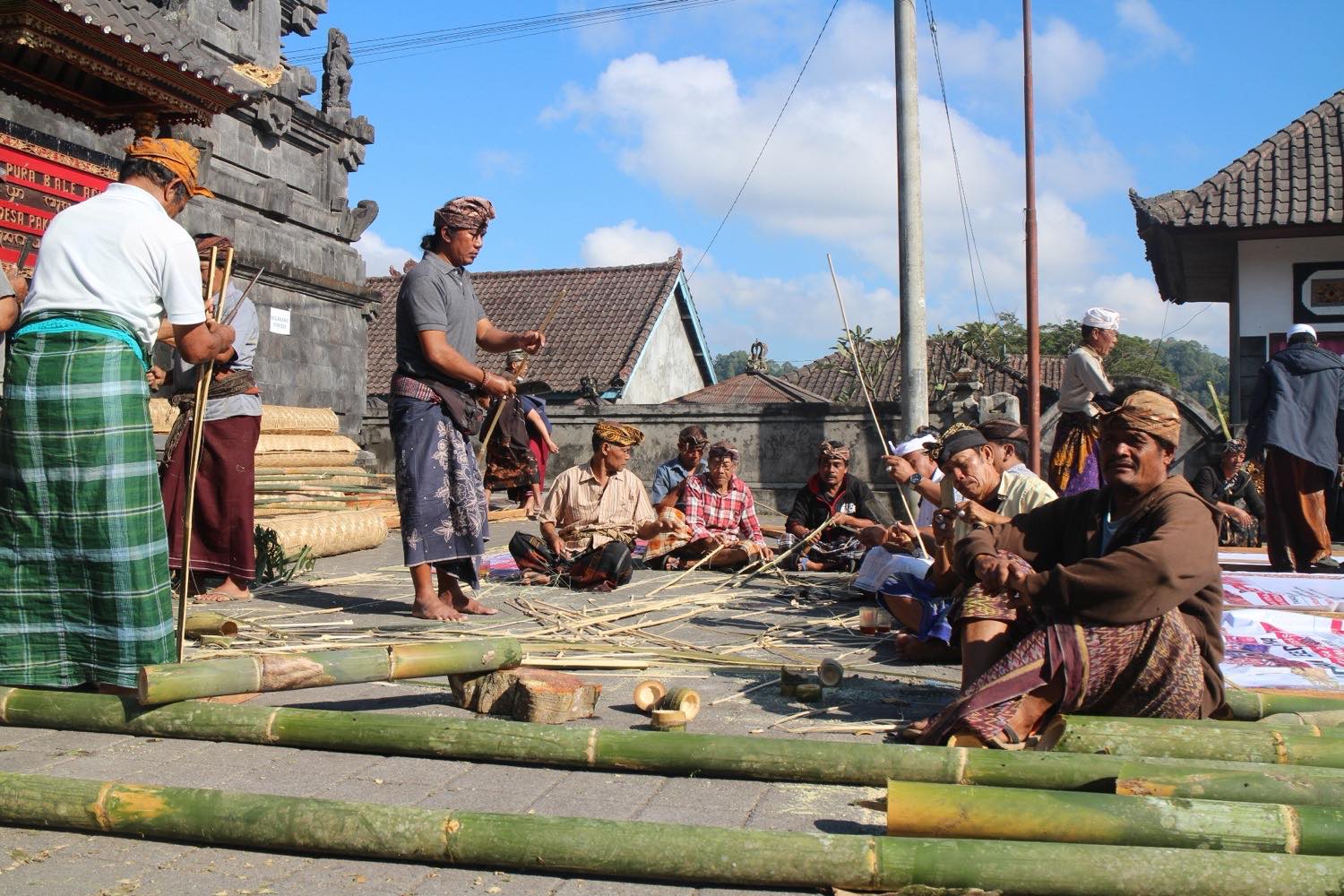 Men working bamboo for a customary ceremony, a common share of the ngayah. Photo: Michaelparikesit / Wikimedia Commons (CC BY-SA 4.0)

What Ngayah Looks Like, from Bamboo to Gamelan
The work at a temple festival is shared out by long custom.
The men prepare everything made of bamboo and do the decorating, Suka Ardiyasa writes, while the women make the offerings, the banten. The young people decorate and clean, and young women help with the banten too.
Buleleng's own government pages show the range in the north:
- A subak: Subak Abe in Selat cleaned its subak temple, repaired a road and cleared the channel feeding its rice fields.
- A village temple: About 50 young people from Banjar Jawa cleaned the grounds of Pura Desa Adat Buleleng. They also put the ceremonial gear back in order after a ceremony.
- The gamelan: The culture office's own gamelan group, Praja Gurnita, played as ngayah for a temple festival at the regent's office.
- The city temple: Civil servants offered ngayah for the yearly festival of Pura Agung Jagatnatha in Singaraja.
The north's choirs of sacred song sing as ngayah too, as told in the songs of Bali. The subak itself is explained in the subak rice terraces.
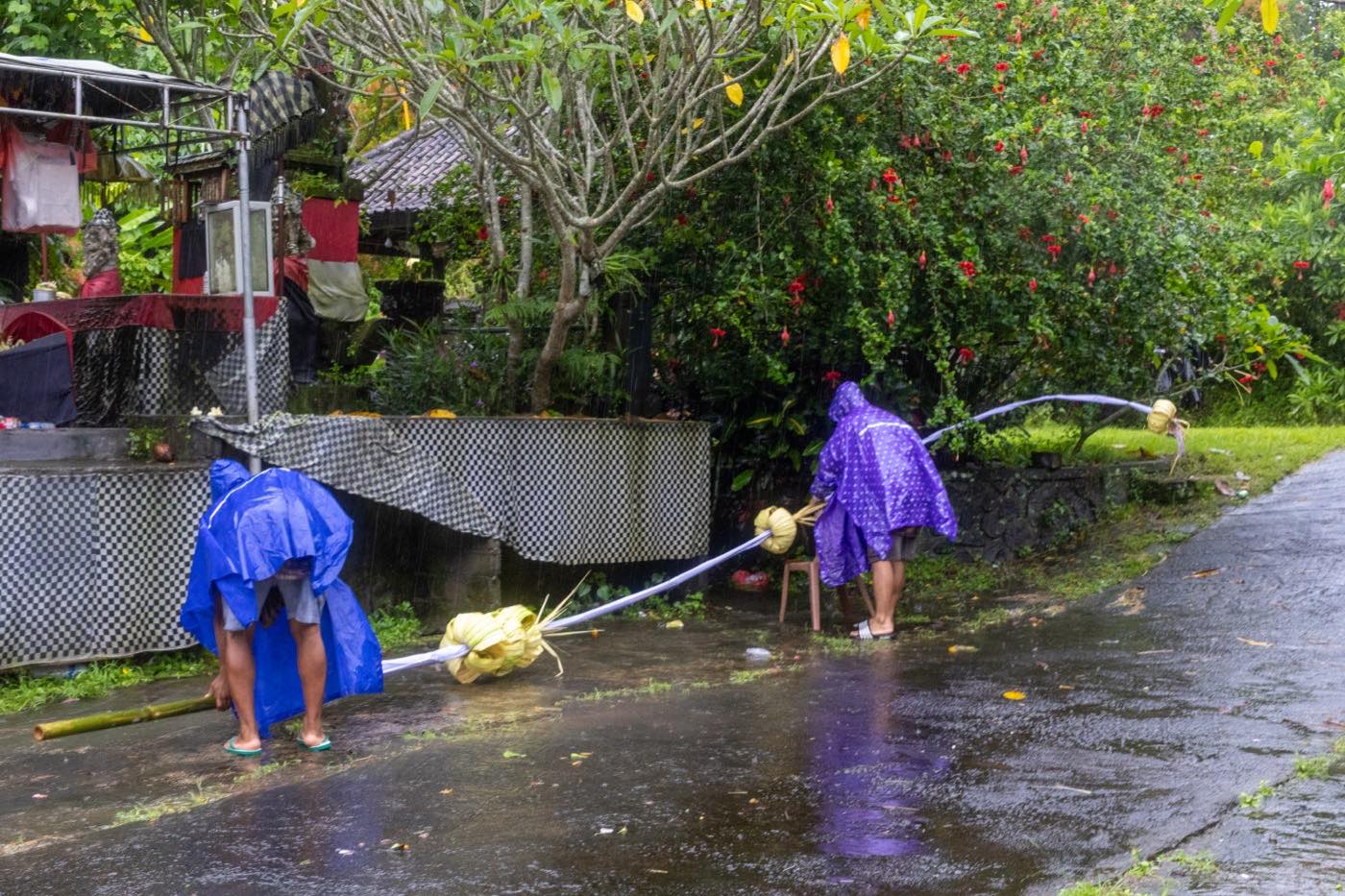 Villagers carry a ceremonial decoration in the rain during ngayah for Pura Luhur Tamba Waras, Tabanan. Photo: Luh Gede Krismayanti / Wikimedia Commons (CC BY-SA 4.0)

Ngayah Brings Neighbours Together, and Office Hours Test It
Ngayah is how a village gets to know itself.
Wiriyanti gives an example in Bali Post. A woman who marries into a banjar knows no one at first, and ngayah is where she meets her new neighbours. The only hope behind the work, she writes, is that the banjar will come and help in turn.
The demands are real, and the ngayah for a cremation can run for a week. Wiriyanti cites 2017 figures from Statistics Indonesia showing nearly half of Bali's workforce employed as wage workers on fixed hours. Civil servants, she notes, often spend their twelve days of yearly leave on banjar ngayah.
She suggests the form may change while the tradition stays, a week of preparation shortened to two days. The full cremation is described in ngaben, the Balinese cremation.
How to Behave Around Ngayah as a Guest
Ngayah belongs to the members of a village and its temple. It is not a tour or an activity you can book.
You will notice it in the days before a ceremony. People sit in the banjar hall making offerings, and men split bamboo in a temple forecourt. A few habits help:
- Give the work room. Walk around people and materials, and walk around offerings laid out on the ground.
- Ask before you photograph anyone at work, and lower the camera if the answer is no.
- Dress for the temple if you go inside. The temple etiquette guide has the details.
- If you are invited to help, follow the lead of the person who invited you and do what you are shown.
Long-term residents are sometimes drawn in to the work. The British man born and raised in Bali, Afandy Dharma Fairbrother, took part in his Kuta banjar's ngayah, Bali Post reported. He cited it when he applied for Indonesian citizenship.
FAQ
What is ngayah? Ngayah is the Balinese tradition of working without pay for the temple and the customary village. It is understood as service offered to God, following karma marga, the path of selfless action. It covers making offerings, bamboo and decoration work, cleaning temple grounds, and playing gamelan or dancing at ceremonies.
Where does the word ngayah come from? From the Balinese ayah, service, with the related words ayahan, pengayah and ngayahang. A Ministry of Religious Affairs counsellor traces it to the age of the Balinese kings. Households then held village land, tanah ayahan desa, in return for duties to the temple, the banjar and the palace.
What is the difference between ngayah and gotong royong? Gotong royong is the Indonesia-wide ethos of working together, "joint bearing of burdens". Ngayah is done in that spirit, but it is directed upward, to God, the temple and the village. Help between relatives at a family ceremony has its own Balinese name, nguopin.
What are the benefits of ngayah? Kompas lists solidarity in the community, harmony between faiths and help with social and environmental problems. Bali Post adds that ngayah is where neighbours get to know one another, including newcomers who marry into the banjar. For the person serving, Suka Ardiyasa names the reward as satisfaction, not money.
Is ngayah compulsory? For full members of a customary village, yes. Bali's 2019 regulation on customary villages includes physical work, ayah-ayahan, among their duties under the village's own rules. Those who miss it may pay a customary fine, and the social cost weighs more.
Can tourists join ngayah? Ngayah belongs to the members of a village and its temple, so it is not something to book. Long-term residents are sometimes welcomed in, as a British man born and raised in Bali was in his banjar in Kuta. If you are invited, follow the lead of the person who asked you.
Sources
- Kementerian Agama RI, I Wayan Sudarma, Ngayah (pengabdian) sebagai wujud gotong royong dan toleransi, 12 November 2025 (literal meaning from the 1990 Balinese-Indonesian dictionary, ayahan land and the three duties, ngayah ke pura, banjar, puri and gerya, work as worship, Bhagavad Gita 2.47, narrow and wide ngayah), read October 2026 (in Indonesian)
- tatkala.co, Suka Ardiyasa, "Ngayah" bukan "lelah sing mabayah", 26 September 2019 (ayah as service, pengayah, ngopin and menyama braya, the division of work at a Kahyangan Tiga festival), read October 2026 (in Indonesian)
- detikBali, Ni Made Gita Julianti, Apa itu ngayah dalam tradisi masyarakat Bali?, 20 August 2025, read October 2026 (in Indonesian)
- Kompas, Tradisi ngayah di Bali: manfaat dan contoh, 8 November 2023 (benefits), read October 2026 (in Indonesian)
- Bali Post, Desak Gede Prita Widia Wiriyanti, Masa depan tradisi ngayah, 23 July 2019 (opinion: fines and social sanction, newcomers, cremation ngayah, working hours and leave), read October 2026 (in Indonesian)
- Bali Post, Aktif ngayah dan manyama braya, WNA ini ingin jadi WNI, 9 November 2021, read October 2026 (in Indonesian)
- Provinsi Bali, Peraturan Daerah Nomor 4 Tahun 2019 tentang Desa Adat di Bali (full and limited duties, pawedalan and ayah-ayahan, tanah ayahan desa adat), read October 2026 (in Indonesian)
- Pemerintah Kabupaten Buleleng: Kegiatan ngayah Subak Abe Desa Selat (10 February 2021), Ngayah di Pura Desa Adat Buleleng (19 May 2025), Sekaa Gong Praja Gurnita ngayah (13 January 2025), Ngaturang ngayah di Pura Jagatnatha (July 2025) and Ngayah sebagai penyuluh agama Hindu, Gede Cakra, read October 2026 (in Indonesian)
- Wikipedia, Communal work (gotong royong, its meaning and Sukarno's 1945 speech), read October 2026 (in English)
Read next: the Balinese banjar, understanding Balinese ceremonies, Tri Hita Karana and the gebogan.