On this page
- In Brief
- Air Sanih at a Glance
- Fresh Water Rises a Few Metres From the Sea
- In Local Understanding the Water Comes From Batur
- Two Stone Pools, One for Adults and One for Children
- The Village Looks After the Spring and Its Temples
- Every 840 Days the Village Keeps Its Own Nyepi
- East of the Pools, a Holy Shore Is Returning to Ceremony
- Families Fill the Pools After Galungan and Lebaran
- How to Visit Air Sanih
- How to Fit It In
- FAQ
- Sources
In Brief
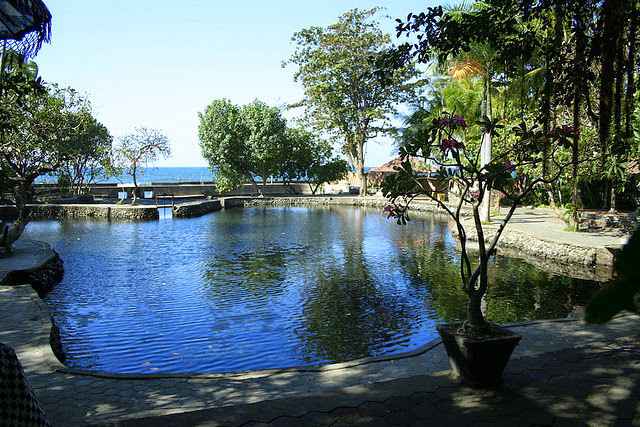
Air Sanih is a natural freshwater spring and bathing place on the coast of Kubutambahan district, about 17 kilometres east of Singaraja in north Bali. The spring fills two stone-walled pools, a deep one for adults and a shallow one for children. The sea lies a few metres away, and the fresh water stays fresh.
The village runs it, and the income helps pay for the village's ceremonies. The spring is also holy water for the village temples. Every 840 days the village keeps its own Nyepi, and the pools close to visitors for that day.
Air Sanih at a Glance
- What it is: a spring-fed freshwater bathing place, pemandian, beside the beach
- Also called: Yeh Sanih. Yeh is Balinese for water, and Sanih is the village
- Where: Sanih, in the administrative village of Bukti, Kubutambahan district, on the coast road east of Singaraja (Map)
- Distance: about 17 km from Singaraja by the village's count, 18 km by a university study
- The pools: one about 1.5 m deep for adults, one shallow pool for children
- The grounds: about 64 are, roughly 6,400 square metres
- Run by: the village, with the income going to its ceremonies
- Closes: for a day at the village's own Nyepi, on Tilem Sasih Karo every 840 days
- Busy: on the day after Galungan and the second day of Lebaran
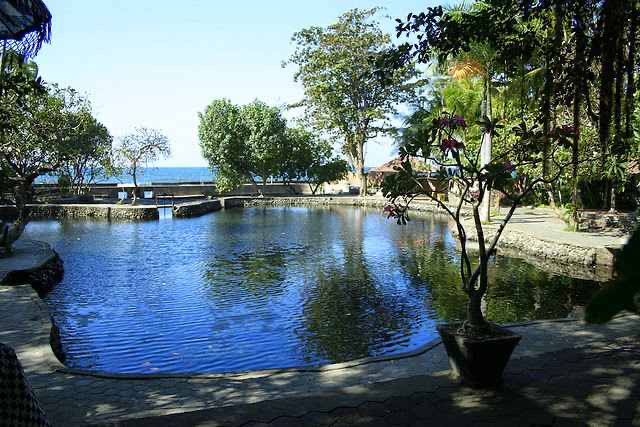 The large spring-fed pool at Air Sanih, with the sea just beyond its far wall. Photo: Palm Living.
Fresh Water Rises a Few Metres From the Sea
In the words of a Kompas report, the fresh water never mixes with the salt sea a few metres away.
The Buleleng communications office, reprinting a Kompas report, dates the clear spring to around 1930. The village of Bukti says Air Sanih has been a local bathing place since the same year.
In the report's account, the water first passes a temple set higher than the beach. What fills the pools is the last outflow after the temple. It runs in at several points between the stones that form the pool walls.
The source itself is called Yeh Kelebutan, according to detikTravel. It rises south of the adult pool, under a frangipani tree beside a temple to Wisnu. The village and a Universitas Pendidikan Ganesha study place it at the pool's south-eastern corner.
Ketut Sumanasa, the manager quoted in the Kompas report, said the spring never dries, even in the dry season.
In Local Understanding the Water Comes From Batur
The people of Sanih trace their spring far inland, to Batur.
In local understanding the water flows there underground. The communications office names Mount Batur, about 40 km away. The village and the Undiksha study name Lake Batur, in Kintamani.
detikTravel recorded the story told to explain it. An old man herded his ducks on Lake Batur and lost one. Days later the same duck was found in the pool at Yeh Sanih.
A second story belongs to couples. In local legend, a young couple who bathe here will stay together, as both the village and detikTravel record.
Two Stone Pools, One for Adults and One for Children
The residents built the pools from stacked stone.
- The large pool is about 1.5 m deep, for adults.
- The small pool is for toddlers and children. The communications office gives its depth as half a metre, and the village gives one metre.
The water is clear and cool. detikTravel notes that no chlorine is added. Small fish swim in it, and the beach sits right in front of the pools.
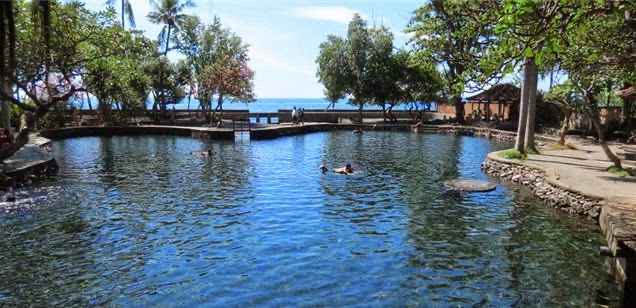 Swimmers in the large pool at Air Sanih, a few steps from the sea. Photo: Palm Living.
According to the Kompas report, the managers drain the pools once a week and clear out rubbish and moss.
The grounds have grown around the spring. The Undiksha study listed a playground, a lotus pond and gazebos along the beach. Writing in Tatkala in 2022, a Kubutambahan-born lecturer found:
- a shallow current pool for small children
- water slides in several sizes
- more changing rooms
- places to rinse after swimming
The communications office also mentions food stalls and children's rides.
The Village Looks After the Spring and Its Temples
Air Sanih is a village spring as well as a bathing place.
Sanih is a desa adat, a customary village, inside the administrative village of Bukti. Bali Express counted 500 households in Desa Pakraman Yeh Sanih in 2017.
The village runs the bathing place, the communications office reports. Its takings help residents pay for their customary ceremonies.
The spring is also holy water. Its water is used as tirta at the temple anniversaries of the village's ten temples, as NusaBali reported. The village names a temple to Wisnu near the pools, and the Undiksha study notes the banyan trees around it.
If you walk up to the temple, dress as you would for any Balinese temple, as Bali temple etiquette explains.
Every 840 Days the Village Keeps Its Own Nyepi
Yeh Sanih keeps two days of silence: the island's Nyepi and one of its own.
The village Nyepi falls on Tilem Sasih Karo, the new moon of the second Balinese month. Kelian Jro Made Sukresna told Bali Express it comes every 840 days by the Balinese reckoning. The village describes this as once every two years.
He said the custom is about 200 years old and is written into the village's awig-awig, its customary law. Its purpose is to honour and purify the holy spring.
NusaBali followed the 2017 observance:
-
The day before, each household made a pacaruan offering at home, with a larger one at the village crossroads.
-
At 6 in the morning, the 24 hours of silence began. Residents did not light fires, work, travel or seek entertainment.
-
The spring source, the ulun tirta south of the pools, was closed and left untouched by anyone for the day.
-
The next morning at 6, daily life resumed.
The village Nyepi also opens the round of anniversaries at the village temples. For those 24 hours the pools are closed to visitors as well. Pecalang, the village guards, stood at the entrance in 2017 and turned away anyone who came to swim.
Traffic on the main coast road still passes. The rule binds the villagers, and other travellers may drive through, as the village head told Tribun Bali.
The village announced the 2017 date ahead of time, on notices around the village and through social and broadcast media. How the Balinese months and new moons are counted is in the Balinese calendar explained.
East of the Pools, a Holy Shore Is Returning to Ceremony
The ground east of the pools has its own sacred role.
In August 2026 NusaBali reported that Desa Adat Yeh Sanih had won a long court case over about 5,580 square metres of state land there. A final review ruling of 26 February 2026 upheld the village's claim, dating from 2015.
The village wants the land back for ceremony:
- melasti, the purifying procession to the sea
- nganyud, part of the cremation rites
At least seven customary villages use the shore for these rites, the village head said. He named:
- Yeh Sanih
- Depeha
- Batur
- Bungkulan
- Mengening
- Bukti
Residents from around Kubutambahan come as well.
There is a holy spring on the land as well. The Pesimpangan Tirta Sudamala has long been known as a place for melukat, the purifying bath. The village plans a place for melukat open to the public once the land is formally granted.
Families Fill the Pools After Galungan and Lebaran
Air Sanih is a favourite swim for families in east Buleleng.
On Umanis Galungan, the day after Galungan, Tatkala's writer found hundreds of people at the pools. He had come by bemo as a child with his grandmother.
The village of Bukti records a second annual gathering. On the second day of Lebaran, local Muslim families come in groups with their relatives. The village counts it as menyama braya, the Balinese way of kinship between faiths and peoples.
How to Visit Air Sanih
- Getting there: the pools sit beside the main coast road east of Singaraja, in Kubutambahan district. The north Bali map shows the road.
- Entry: by ticket at the gate. Check the current rate there.
- Avoid the village Nyepi: the pools close for its 24 hours. Ask locally before a long drive if you are travelling around a new moon.
- Choose your day: the day after Galungan and the second day of Lebaran bring the biggest local crowds.
- Bring children: the shallow pool is built for them. Watch them on the slides and in the current pool.
- Respect the spring: the source and the Wisnu temple are holy, and the source supplies holy water to the village. Follow any sign or village guard.
- Stay for the light: the Kompas report praises the late afternoon, when the sun goes down over the beach in front of the pools.
How to Fit It In
Air Sanih pairs well with Kubutambahan's temple. Pura Maduwe Karang, also spelled Meduwe Karang, has a carved relief of a man on a bicycle. The Kompas report places it not far from Yeh Sanih, back toward Singaraja.
For a swim of a different kind, the Banjar hot springs lie west of Lovina. For sea swimming along the coast, read the best beaches in north Bali.
FAQ
What is the Air Sanih natural spring?
A freshwater spring on the beach at Sanih, east of Singaraja, gathered into two stone pools for bathing. The water rises a few metres from the sea and stays fresh. It has been a local bathing place since about 1930.
Where is Air Sanih in Bali?
In Sanih, part of the village of Bukti in Kubutambahan district, Buleleng. It sits on the coast road about 17 to 18 km east of Singaraja.
What does Yeh Sanih mean?
Yeh is Balinese for water, and Sanih is the name of the village. Air Sanih is the same name with the Indonesian word for water.
Is the water at Air Sanih salty?
No. The pools hold fresh spring water, cool and clear, even though the sea is only a few metres away. In local understanding the water flows underground from Batur.
Is Air Sanih good for children?
Yes. A separate shallow pool is built for toddlers and children, and the grounds have added a current pool and slides. The large pool is about 1.5 m deep, for adults.
When is Air Sanih closed?
For 24 hours during the village's own Nyepi, on Tilem Sasih Karo every 840 days by the Balinese calendar, about every two years. Villagers then keep a day of silence to honour the spring, and no one may enter the pools.
Who manages Air Sanih?
The village of Sanih, according to the Buleleng communications office. Its income helps fund the village ceremonies, and the spring supplies holy water to its ten temples.
Sources
- Dinas Komunikasi, Informatika, Persandian dan Statistik Kabupaten Buleleng, Pemandian air tawar di tepian pantai, a Kompas report by Ayu Sulistyowati (the spring from about 1930, Mount Batur, the water passing the temple, the two pools and their depths, the 64 are, weekly cleaning, the manager Ketut Sumanasa, village management and ceremony income, the closure for the village Nyepi, the late-afternoon view), Indonesian, read October 2026
- Desa Bukti, Kolam Renang Alam Air Sanih, October 2018 (17 km from Singaraja, known since 1930, Lake Batur, the source at the south-eastern corner, the couples legend, the children's pool, the Wisnu temple, the Lebaran gathering), Indonesian, read October 2026
- Rasmita Dewi and Adi, Universitas Pendidikan Ganesha, Perkembangan daya tarik objek wisata Air Sanih Desa Bukti, 2014 (Dusun Yeh Sanih in Desa Bukti, 18 km from Singaraja, 64 are, the playground, lotus pond and gazebos, the temple and banyans, the source at the south-eastern corner, Lake Batur in Kintamani), Indonesian, read October 2026
- detikTravel, Yeh Sanih, pemandian di Bali yang punya mitos awet jodoh, November 2015 (Yeh Kelebutan under the frangipani by the Wisnu shrine, the duck story, the couples legend, no chlorine), Indonesian, read October 2026
- Bali Express, Nyepi Desa Yeh Sanih digelar 840 hari sekali sejak 200 tahun silam, August 2017 (Desa Pakraman Yeh Sanih in Banjar Dinas Sanih, Desa Bukti, 500 households, Tilem Sasih Karo every 840 days, 200 years, the awig-awig, the guards at the pools), Indonesian, read October 2026
- NusaBali, Pembersihan patirtan tiap dua tahun sekali, August 2017 (the pacaruan, the 24 hours from 6am, the closed ulun tirta, tirta for ten temples, the advance notices), Indonesian, read October 2026
- Tribun Bali, Keunikan ritual Desa Yeh Sanih gelar Nyepi adat, August 2017 (through traffic allowed during the village Nyepi), Indonesian, read October 2026
- NusaBali, Usai sengketa hukum, Desa Adat Yeh Sanih siapkan permohonan tanah negara, August 2026 (the land east of the pools, the court rulings, melasti and nganyud, the seven villages, Pesimpangan Tirta Sudamala, the melukat plan), Indonesian, read October 2026
- Tatkala, Dilema pariwisata Air Sanih, by Teddy Chrisprimanata Putra, June 2022 (Umanis Galungan crowds, the current pool, slides, changing and rinsing rooms), Indonesian, read October 2026
Read next: the best beaches in north Bali for the rest of the coast, melukat, the purifying bath for the meaning of holy water, and the Banjar hot springs for the other great bathing place of the north.