On this page
- In Brief
- Laklak at a Glance
- Laklak Is a Soft Rice-Flour Cake Served Under Coconut and Palm Sugar
- How Laklak Is Made, Step by Step
- The Name Means "Do Not Be Careless About the Life to Come"
- Laklak Began as an Offering, in a Story That Reaches Pura Pulaki
- Indonesia Listed Laklak as National Heritage in 2022
- Buleleng Gave Laklak Two New Versions
- Where to Eat Laklak in North Bali
- How to Fit It In
- Practical Notes
- FAQ
- Sources
In Brief
Laklak, also written lak lak and called jaja or jaje laklak in Bali, is a small traditional Balinese cake. A runny rice-flour batter is cooked in a round clay mould with several hollows. The little cakes are lined up on a plate or leaf, scattered with grated coconut and soaked with melted palm sugar.
It has two lives. Laklak is a ceremonial offering, named in palm-leaf manuscripts for the five great categories of Balinese ritual. It is also an everyday snack, eaten with coffee or tea in the morning or afternoon. In 2022 Indonesia listed it as national intangible cultural heritage.
North Bali added its own versions. Fruit laklak comes from Pancasari, on the mountain road between Bedugul and Singaraja. Laklak kelor, green from moringa leaves, comes from the village of Dencarik and is sold at the Lovina Sunday Market.
Laklak at a Glance
- What it is: A small, round, soft rice-flour cake, 3 centimetres across in the provincial culture record
- Names: Laklak, lak lak, jaja laklak, jaje laklak, kue laklak
- Colours: Usually white, and also green, black or pink
- The batter: Rice flour with water, coconut milk and salt, and suji leaf juice for green
- Served with: Grated coconut and melted palm sugar, a syrup called kinca
- Cooked in: A clay mould with round hollows, called a pelaklakan, over a wood fire or a stove
- Eaten: With coffee or tea, morning or afternoon, and offered in ceremonies
- Heritage status: Indonesian intangible cultural heritage since 2022
- North Bali versions: Fruit laklak from Pancasari, laklak kelor from Dencarik
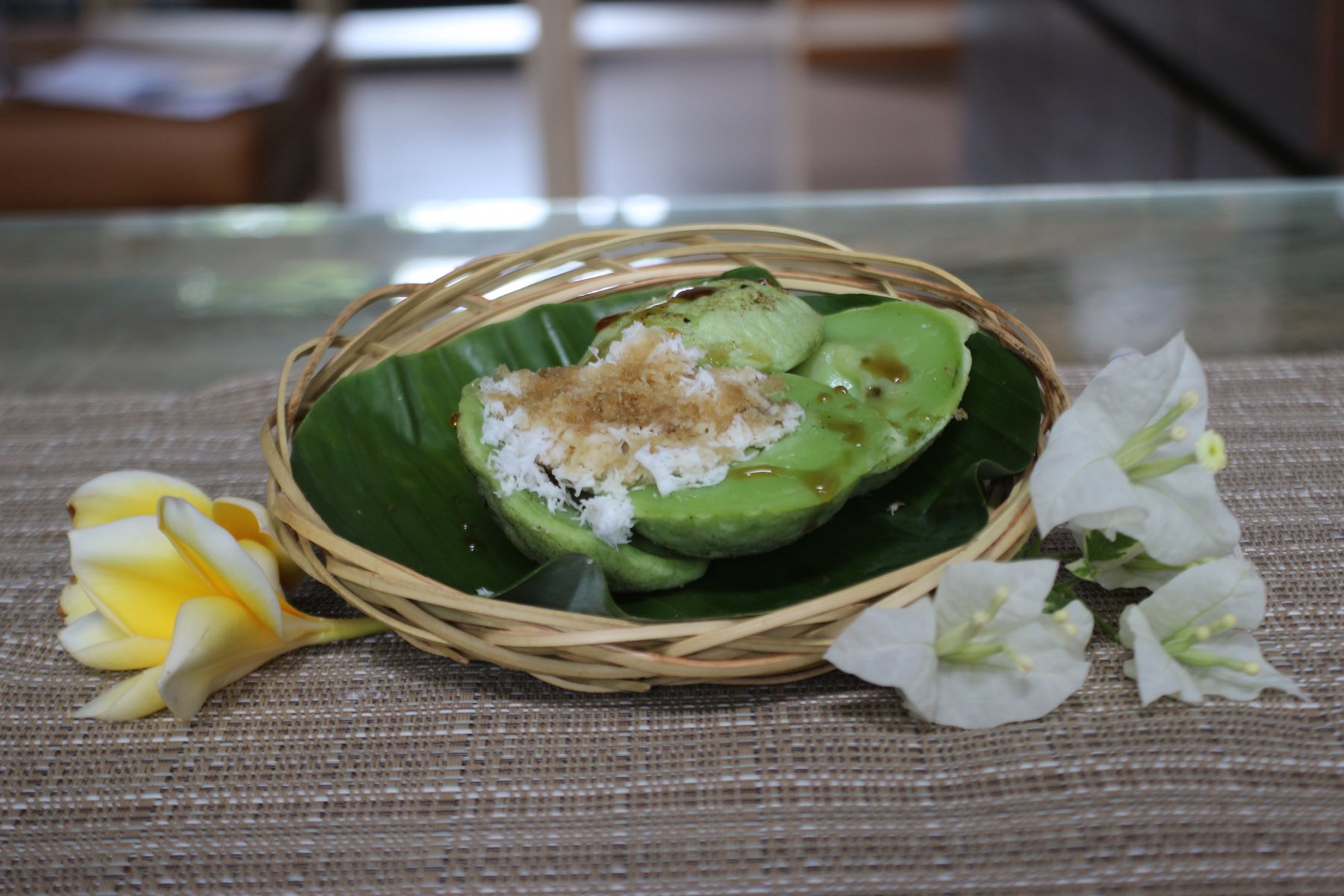 Green laklak with grated coconut and palm sugar syrup, served in a woven basket on banana leaf. Photo: Joseagush / Wikimedia Commons (CC BY-SA 4.0)
Laklak Is a Soft Rice-Flour Cake Served Under Coconut and Palm Sugar
Jaja is the Balinese word for cake or snack, and laklak is one of the island's kue basah, the soft, moist cakes.
The Ceraken Kebudayaan Bali, the provincial government's culture record, describes a small round cake 3 centimetres across. It is usually white, and green, black and pink versions are made too. The cakes are served in a row on a plate, on paper or on a leaf, then dressed with coconut and syrup.
Buleleng's culture and tourism office compares laklak with the serabi of Java and the surabi of West Java. In its account, green laklak takes its colour from suji leaf and white laklak from coconut milk. Cooking over firewood gives it a flavour of its own.
How Laklak Is Made, Step by Step
The provincial record calls laklak simple enough for children, young people and older people to make.
Its notes on ingredients are practical. Freshly milled rice flour keeps the cakes soft. Water and coconut milk thin the flour into a runny batter. For the topping, coconut that is not too old tastes sweeter.
Kompas published a home recipe from Ayu Rini's 2013 book on Balinese cakes, Jajanan Khas Pulau Dewata. It uses:
- 500 grams of rice flour
- 50 grams of glutinous rice flour
- suji leaf water
- salt
- grated coconut
- for the kinca: 400 grams of palm sugar, 350 millilitres of water and three pandan leaves
The method, in that recipe's order:
-
Mix the two flours. Scald them with a little hot water, leave until lukewarm, then add salt.
-
Work in the suji leaf water a little at a time, until the batter is as thick as a banana fritter batter.
-
Heat the clay mould. The recipe lays a piece of coconut husk (kulit kelapa) in it until it chars, then removes it. A non-stick pan or snack maker works if you have no clay mould.
-
Pour a ladle of batter into the mould and put on the lid. Cook it over the fire, or over a low stove flame, until the surface is pitted with small holes and the cake is done.
-
Prise the cakes out and line them up on a plate. Scatter with grated coconut and pour over the kinca.
The clay pan has a name of its own, pelaklakan, detikTravel notes. The provincial record adds two touches. The mould is rubbed with coconut oil so the cakes do not stick. The lid spreads the heat over the top of each cake, so it cooks through in a few minutes.
The Name Means "Do Not Be Careless About the Life to Come"
The name carries a teaching.
In the reading the provincial record gives, la (said le) means careless and lak means what is still to come. Laklak is a reminder to stay watchful in this life. The record cites the palm-leaf text Dwijendra Tatwa for it. Indonesian Wikipedia adds that local tradition understands it as eling lan waspada, to remember and stay alert.
Laklak Began as an Offering, in a Story That Reaches Pura Pulaki
In Balinese tradition, laklak entered the offerings through the priest Dang Hyang Nirartha, who came to Bali from Java in 1500, in the provincial record's dating.
Buleleng's culture office tells the story in full. After landing from Blambangan, Nirartha entered the open mouth of a great serpent in the forest. Inside he found three lotus flowers, dark blue, red and white. He came out with his body shifting colour, from black to white to red.
His wife and children fled in fear. His children were found again, except one daughter, Ida Diah Swabawa. She and his wife could not be found anywhere, and he took them to have died. So that their souls would not wander, he performed a purifying ceremony. Mother and daughter are honoured as Dewi Melanting at Pura Pulaki, the sea temple on Buleleng's northwest coast.
Another daughter, Ida Rai Istri, had not run. She was given power over the unseen beings, with the title Ratu Niang Sakti. Her one request was an offering of laklak tape. From then, in this account, laklak tape has been offered to the bhuta so they do not disturb human life.
The provincial record traces what followed. Nirartha became royal priest at Gelgel under Dalem Waturenggong, with the title Dang Hyang Dwijendra. Two later palm-leaf manuscripts, the Lontar Tegesing Sarwa Bebanten and the Lontar Dewa Tatwa, confirm its place. They name laklak as an offering for every ceremony of the Panca Yadnya, the five categories of ritual.
Interviews made for the record in 2021, at two geriya in Punggul, explain what it holds in each:
- In ceremonies for the gods (Dewa Yadnya), Ida Bagus Eka Giriarta described laklak as the union of sun, moon and star, which together form the sacred syllable Ongkara.
- In rites of passage (Manusa Yadnya), Ida Pedanda Gede Buruan Manuaba described it as payment to three witnesses: the gods, the people and the unseen beings.
- In offerings to the unseen (Bhuta Yadnya), he described laklak tape as the balance of the three worlds, below, middle and above.
The same record reads laklak as a symbol of the Dewa Tri Murti, God in three forms. Balinese offerings explained covers where cakes like this sit in a banten.
Indonesia Listed Laklak as National Heritage in 2022
Laklak was one of nine proposals from Bali passed as Indonesian intangible cultural heritage in 2022, detikBali reported. Arak Bali, lontar Bali, sate lilit and the sea salt of Amed were among the others.
Indonesian Wikipedia records the decree as No. 414/P/2022, in the domain of traditional skills and craftsmanship. The provincial record notes how the skill is passed on: through the banjar adat, the village community, and within families.
Buleleng Gave Laklak Two New Versions
As tourism grew in the 1980s, laklak was developed for eating as well as for offering, and the north had a hand in it.
The provincial record credits I Ketut Sutarman with laklak biu, banana laklak, in Penebel, Tabanan, in the 1980s. In 1990, I Gede Rena of Pancasari, in Buleleng's Sukasada district, developed laklak in fruit flavours.
tatkala.co interviewed I Gede Rena Purdiasa of Pancasari in 2021. It reports his laklak in green, yellow and red, sold beside the Singaraja to Bedugul road, and dates his roadside warung to 2017.
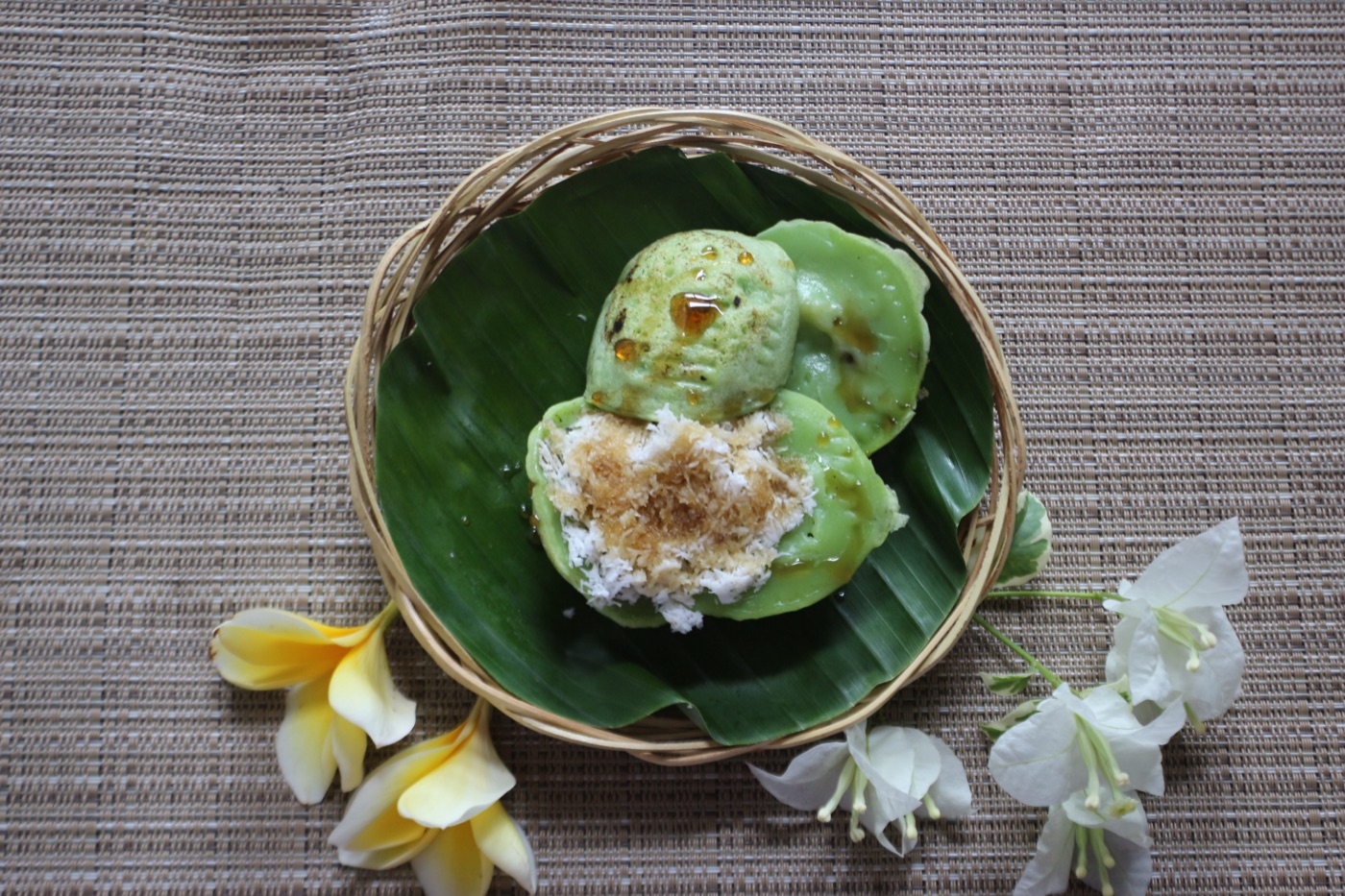 Green laklak on banana leaf, seen from above. Photo: Joseagush / Wikimedia Commons (CC BY-SA 4.0)
Laklak Kelor, Green from Moringa
Laklak kelor was created by Ketut Darmada, a farmer from Banjar Dinas Bajangan in Dencarik village, Banjar district. NusaBali reported that he dries kelor (moringa) leaves at room temperature for 14 days and grinds them to powder. The powder replaces suji as the colour, at 100 grams to 500 grams of rice flour.
He told RRI Singaraja the idea grew out of farming kelor and milling it into flour. Buleleng's government names laklak kelor as a regency speciality, in its notice opening the Lovina Sunday Market.
Laklak Gadang, Green from Suji
Some Lovina sellers have their own name for the classic green cake. Dencarik's village office wrote of sellers at Tanjung Alam, in Kaliasem, who call their laklak laklak gadang for its green suji colour. Their spot is on the Seririt to Singaraja road, in the Lovina area.
Where to Eat Laklak in North Bali
Laklak is sold at traditional markets, warungs and cake sellers, according to Buleleng's culture office. These are the north-coast places with a source behind them:
- The Lovina Sunday Market, on the beach at Kaliasem, where laklak kelor is on the tables. The Lovina Sunday Market guide explains how to check it is on.
- The Buleleng Festival in Singaraja, where laklak kelor has appeared among the village heritage foods. See the Buleleng Festival guide.
- Pancasari, on the Singaraja to Bedugul road, home of fruit laklak. The Bedugul guide covers the rest of the highlands.
- Banyuning, in Singaraja. The neighbourhood office has profiled Komang Suratmi, who cooks laklak in clay moulds at her family warung. Neighbours stop in after morning prayers.
How to Fit It In
Laklak is a snack, so it fits around the rest of the day.
On a Sunday, follow a morning dolphin trip with laklak kelor at the beach market. Driving north from the lakes, stop in Pancasari for fruit laklak. In Singaraja, a market morning with laklak and coffee joins well with a walk through the old town.
For something cold beside it, try es daluman, Bali's green leaf jelly. The other cakes of the island, from klepon to pisang rai, are in what to eat in Bali. Bali street food covers the evening stalls.
Practical Notes
- Go in the morning or afternoon. Those are the coffee and tea hours that Buleleng's culture office ties laklak to.
- Ask by name: laklak kelor for the moringa version, laklak biu for banana.
- Bring small notes for market stalls and warungs.
- Vegetarians: the batters in these sources are rice flour, water or coconut milk, leaf juice and salt, with coconut and palm sugar on top.
- At home: Kompas's recipe works in a non-stick pan if you have no clay mould.
FAQ
What is laklak? Laklak is a small, round traditional Balinese cake made from rice-flour batter cooked in a clay mould. It is served with grated coconut and melted palm sugar. It is both an everyday snack and a ceremonial offering, and Indonesia listed it as national intangible cultural heritage in 2022.
What does laklak mean? In the reading given by Bali's provincial culture record, la (said le) means careless and lak means what is still to come. Together the name is a reminder not to be careless about the life ahead. Jaja or jaje is the Balinese word for cake.
What is laklak in English? There is no settled English name. It is usually described as a small Balinese rice-flour pancake, as in English Wikipedia's entry, or as Bali's cousin of the Javanese serabi.
How do you make laklak? Mix rice flour with a little glutinous rice flour, scald with hot water, add salt and work in suji leaf water to a thick batter. Cook it in a hot, covered clay mould or a non-stick pan until set. Serve with grated coconut and palm sugar syrup made with pandan leaf.
Why is laklak green? Green laklak takes its colour from suji leaf juice, and pandan is used in some kitchens. In Buleleng, laklak kelor takes its green from dried moringa leaves ground to powder.
Is laklak a breakfast food? It is a snack to eat with coffee or tea, in the morning or the afternoon, according to Buleleng's culture office.
Where can I eat laklak in north Bali? At traditional markets and warungs, at the Lovina Sunday Market and the Buleleng Festival, in Pancasari on the road down from Bedugul, and in Singaraja's neighbourhoods such as Banyuning.
Sources
- Ceraken Kebudayaan Bali (Bali provincial government), Jaja Laklak, 15 April 2025, read October 2026 (in Indonesian)
- Dinas Kebudayaan dan Pariwisata Buleleng, Asal Mula Jaja Laklak, 27 July 2023, read October 2026 (in Indonesian)
- Dinas Kebudayaan dan Pariwisata Buleleng, Sunday Market opened in Lovina, July 2025, read October 2026 (in Indonesian)
- detikBali, Arak Bali and jaja laklak named intangible cultural heritage 2022, read October 2026 (in Indonesian)
- Wikipedia, Jaja Laklak, for the decree number and eling lan waspada, read October 2026 (in Indonesian)
- Kompas, Recipe for jaje laklak, 17 September 2020, from Ayu Rini, Jajanan Khas Pulau Dewata (Gramedia, 2013), read October 2026 (in Indonesian)
- NusaBali, Laklak kelor in Dencarik, 2019, read October 2026 (in Indonesian)
- RRI Singaraja, Laklak kelor, read October 2026 (in Indonesian)
- Desa Dencarik, Laklak kelor and laklak gadang, read October 2026 (in Indonesian)
- tatkala.co, Made Adnyana Ole, Laklak in Pancasari, 11 January 2021, read October 2026 (in Indonesian)
- Kelurahan Banyuning, Laklak and local food in Banyuning, 30 December 2025, read October 2026 (in Indonesian)
- detikTravel, Laklak at the Jatiluwih Festival, September 2018, for the name pelaklakan, read October 2026 (in Indonesian)
- Wikipedia, Laklak (food), read October 2026
Read next: what to eat in Bali, the Lovina Sunday Market, Pura Pulaki and Bali's green leaf jelly, daluman.