
On this page
In Brief
Kecak is a Balinese dance-drama in which a chorus of bare-chested men, seated in rings, chant "cak" in interlocking rhythms while dancers in the centre act out an episode of the Ramayana: Sita carried off by Rahwana, and Rama's rescue with Hanuman and the monkey army. The chorus comes from sanghyang, a trance ritual in which a male choir chants while entranced girls dance. In the early 1930s, in the village of Bedulu near Ubud, the dancer I Wayan Limbak, the villagers and the German painter Walter Spies turned that chorus into a staged drama for foreign audiences, and Limbak's touring troupes made it famous. Kecak counts as an entertainment dance, and it is performed mostly in the south, at Uluwatu, Ubud, Tanah Lot and Garuda Wisnu Kencana. In the north it turns up at festivals.
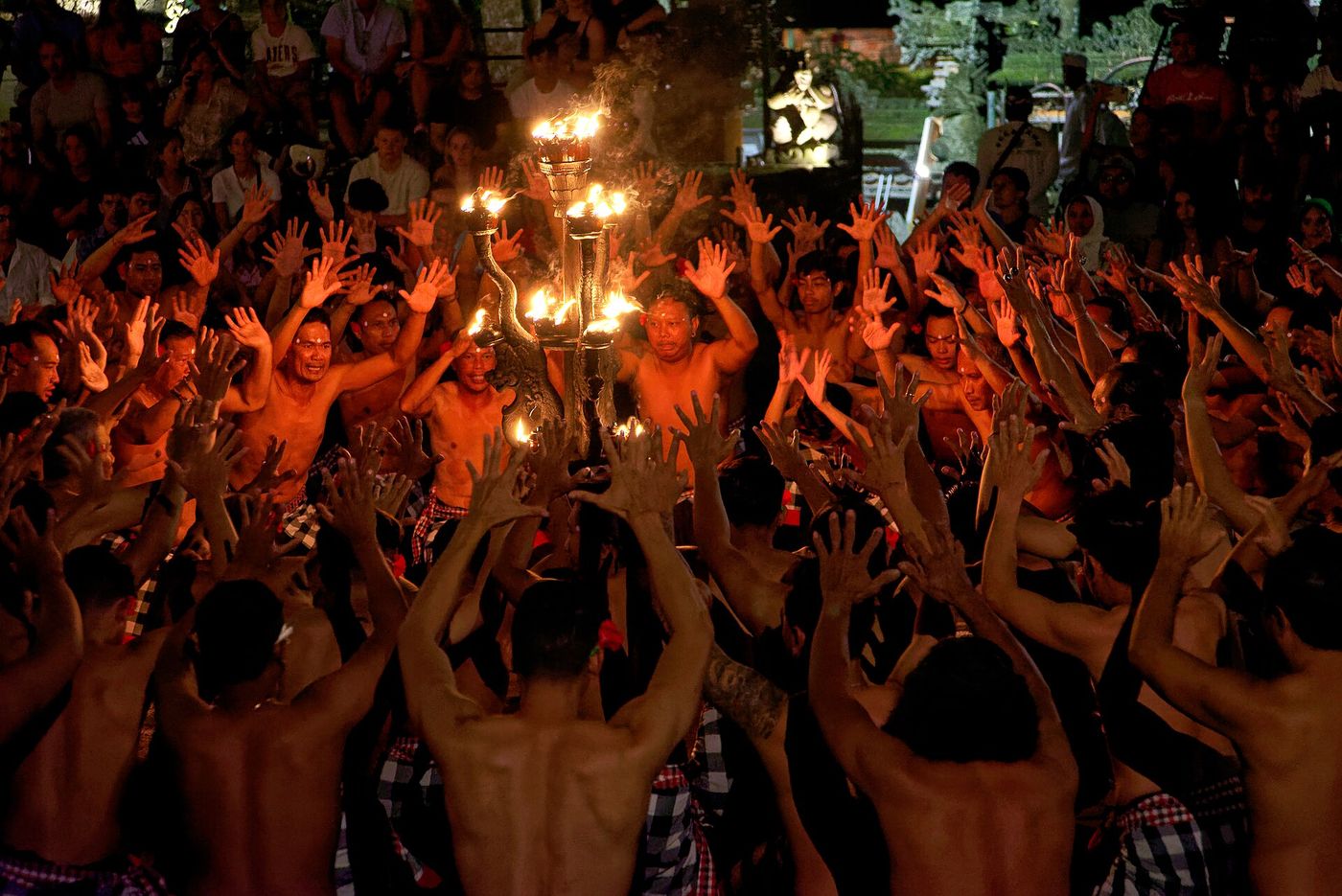 The kecak chorus of the Krama Desa Ubud Kaja group round the lamp, on the open stage at Pura Dalem, Ubud. Photo: Jakub Hałun / Wikimedia Commons (CC BY-SA 4.0)
Kecak at a Glance
- What it is: A dance-drama accompanied only by a male chorus chanting "cak", with no instruments
- The story: Episodes of the Ramayana, usually the abduction of Sita and Hanuman's burning of Rahwana's kingdom
- Roots: Sanghyang, a trance ritual with a male chorus, performed to ward off harm
- Shaped in: Bedulu, near Ubud, in the early 1930s, by I Wayan Limbak, the villagers and Walter Spies
- Dance category: Balih-balihan, entertainment, in the Balinese three-fold system that UNESCO recognised in 2015
- Where to watch: Mainly south Bali; the Ministry of Tourism names Uluwatu Temple, Pura Dalem Taman Kaja in Ubud, Garuda Wisnu Kencana, Melasti Beach and Tanah Lot
- In the north: Occasionally at festivals, such as the Lovina Festival on Binaria Beach
Where Kecak Came From: the Sanghyang Chorus
Before it was a show, the cak chorus belonged to sanghyang. The Buleleng culture office describes sanghyang as a dance tradition in which the dancers enter an unconscious state, communicate with God or the ancestors, and pass their messages on to the community; kecak's chant, it says, was taken from that ritual (Buleleng Culture and Tourism Office). UNESCO's inscription file for Balinese dance lists Sanghyang Dedari among the sacred dances: a trance dance by two young girls, performed to counteract harmful supernatural forces (nomination file).
The ethnomusicologist Kendra Stepputat, author of a book-length study of kecak, describes the full rite as a women's choir preparing the girls, the girls being put into trance, and the male cak chorus accompanying their dancing (Stepputat, 2010).
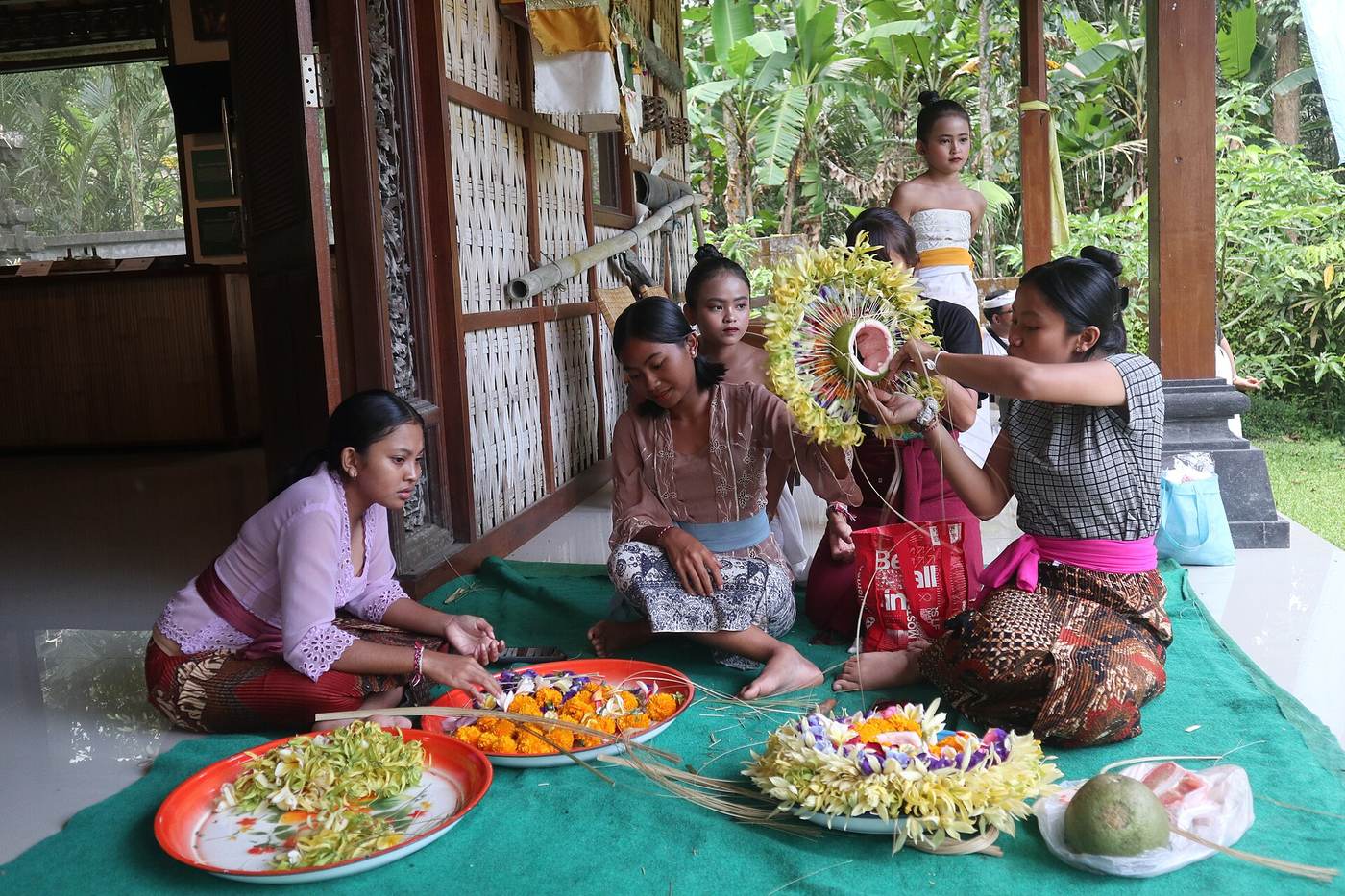 Young women preparing flowers and a headdress before a Sanghyang Dedari ritual in Geriana Kauh, Karangasem. Photo: Kresnanta / Wikimedia Commons (CC BY-SA 4.0)

Sanghyang is still sacred, and the north has it too. In Buleleng's Bali Aga villages, the regency's research agency lists a Tari Sanghyang among the sacred dances young people perform as offerings (Buleleng Research and Innovation Agency). The villages themselves are in the Bali Aga villages of north Bali.
The 1930s: Walter Spies, Wayan Limbak and Bedulu
Walter Spies, a painter and musician born in Moscow to a German family in 1895, settled in Ubud in 1927 (Asian Review of Books). In 1931 and 1932 he helped make the German film Insel der Dämonen (Island of Demons) in Bedulu, released in 1933.
For its final temple festival, Stepputat writes, Spies staged a complete sanghyang dedari rite, with a lamp set in the middle of the male cak chorus, probably, she suggests, to light the faces for the camera. The lamp was new then, and this damar kecak has been part of every kecak since. Many accounts call the film's scene the first kecak; Stepputat's reading is that it was still a sanghyang with minor changes, and that the new drama took shape around the same time, through the collaboration of Spies, the villagers of Bedulu and the dancer I Wayan Limbak.
Limbak's own memory, given to The Jakarta Post in 2002, was the same: the final form came from Spies working with the village elders, with Spies setting the theme and the timing. Limbak danced Kumbakarna, Rahwana's brother (The Jakarta Post). He took his troupe to festivals abroad, which is how kecak became known outside Bali, and he died in Gianyar in 2003, reported to be 106 (Los Angeles Times).
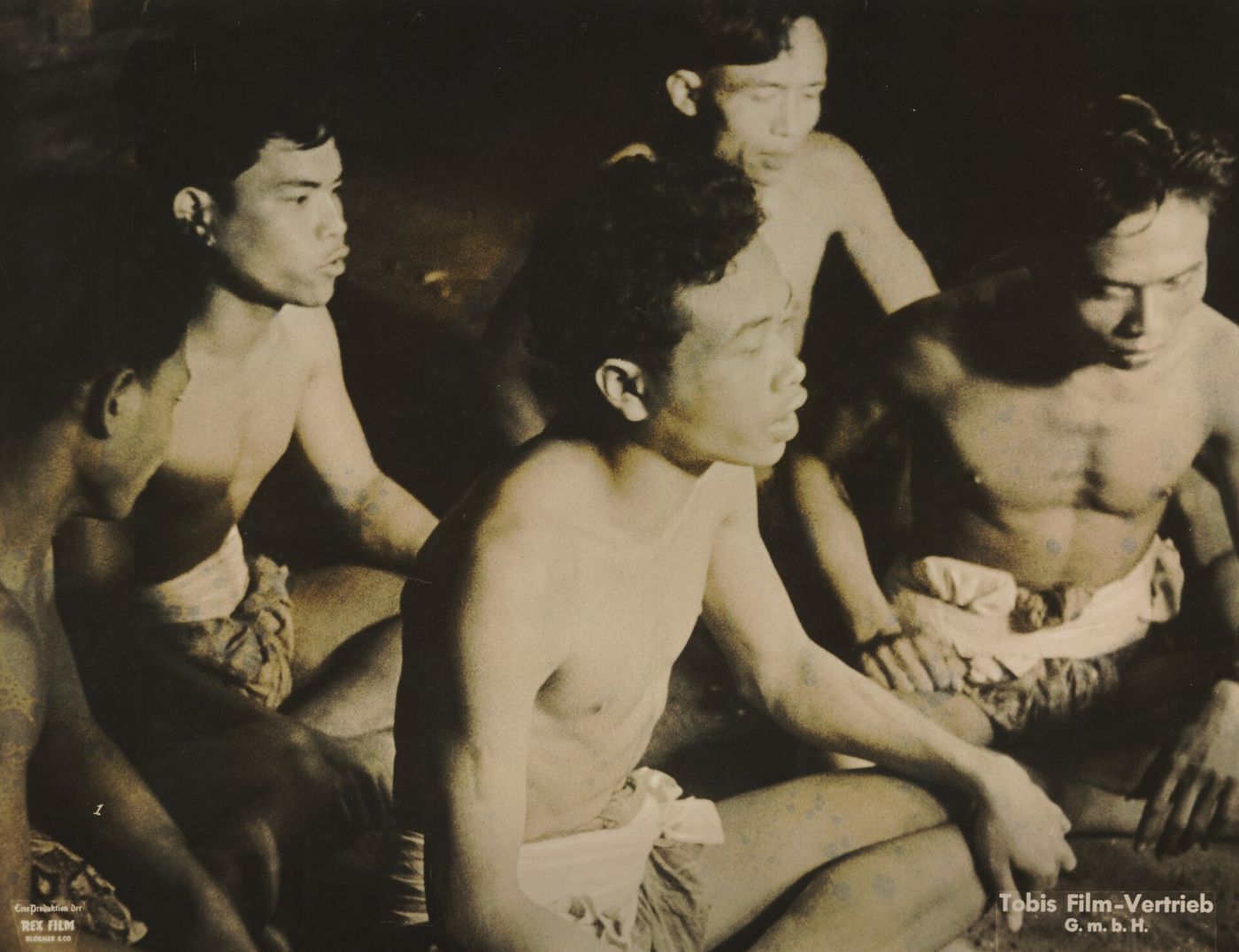 Men of a kecak chorus, in a photograph dated to about 1935. Photo: Unknown author, KITLV / Wikimedia Commons (CC BY 4.0)
Kecak has kept changing. In the 1970s the Javanese choreographer Sardono W. Kusumo worked with the village of Teges Kanginan in Ubud on a kecak with more standing movement and coconut torches (The Jakarta Post). In 2010 the women of Banjar Tengah, Ubud, began a women's kecak, Kecak Luh, trained by I Gusti Lanang Oka Ardika, a dance lecturer at ISI Denpasar (Tribun Bali).
The Story: Scenes From the Ramayana
The Ministry of Tourism says kecak usually presents the part of the Ramayana in which Sita is abducted by Rahwana, and Rama fights to win her back with the help of Hanuman and his monkey army. The most dramatic scene is Hanuman setting fire to Rahwana's kingdom (Indonesia Travel). There is no spoken dialogue. The dancers playing Rama, Sita, Hanuman and Rahwana tell the story in classical Balinese movement, hand gestures and facial expression.
Limbak added other episodes. The Buleleng culture office credits him and Spies with the fight in which the bird Jatayu and Hanuman take on Rahwana's forces, and with the duel of the two monkey kings, Subali and his younger brother Sugriwa (Buleleng Culture and Tourism Office). The chorus becomes the setting too: in The Jakarta Post's description, the rings of men with arms splayed make a dense forest.
What the Chant Is
Kecak has no gamelan. The only instruments are the small bells tied to the ankles of the dancers who play the Ramayana roles (Buleleng Culture and Tourism Office). Everything else is voice, organised the way a gamelan is.
Stepputat explains the machinery. The chorus divides into interlocking parts, and the most common pattern is cak telu, "cak three", three calls repeated over two beats; a skilled group uses up to seven styles. A beat-keeper, the juru klempung, calls "pung" in imitation of the kajar, the gamelan's time-keeping gong. The leader, the juru tarek, from tarek, to pull, calls loudest, setting the tempo and signalling each change and the stop. A third singer, the juru gending, carries the melody and replaces the great gong with a vibrating "sirrr" on every eighth "pung". The Kecak Luh trainer names the patterns his singers had to learn: cak telu nyangsih, cak telu nyangkelod, cak lima and cak nem, all fitted together into one sound.
In UNESCO's inscription file, kecak is listed with the balih-balihan, the entertainment dances, alongside Legong Kraton and the Barong Ket. The Ministry of Tourism adds the Balinese belief that the sound drives away harmful spirits, a purpose that goes back to the exorcism rite it came from.
Where to See Kecak
The Ministry of Tourism names five places, all in the south (Indonesia Travel):
- Uluwatu Temple, on the cliffs of the Bukit peninsula, where the performance is timed to the sunset over the Indian Ocean. More on the temple is in the best temples in Bali.
- Pura Dalem Taman Kaja, Ubud, a more intimate performance by local villagers, within walking distance of central Ubud.
- Garuda Wisnu Kencana Cultural Park, a staged production within the cultural park.
- Melasti Beach, Ungasan, performances on the sand, seasonal; check before you go.
- Tanah Lot, not every day, often as part of special events.
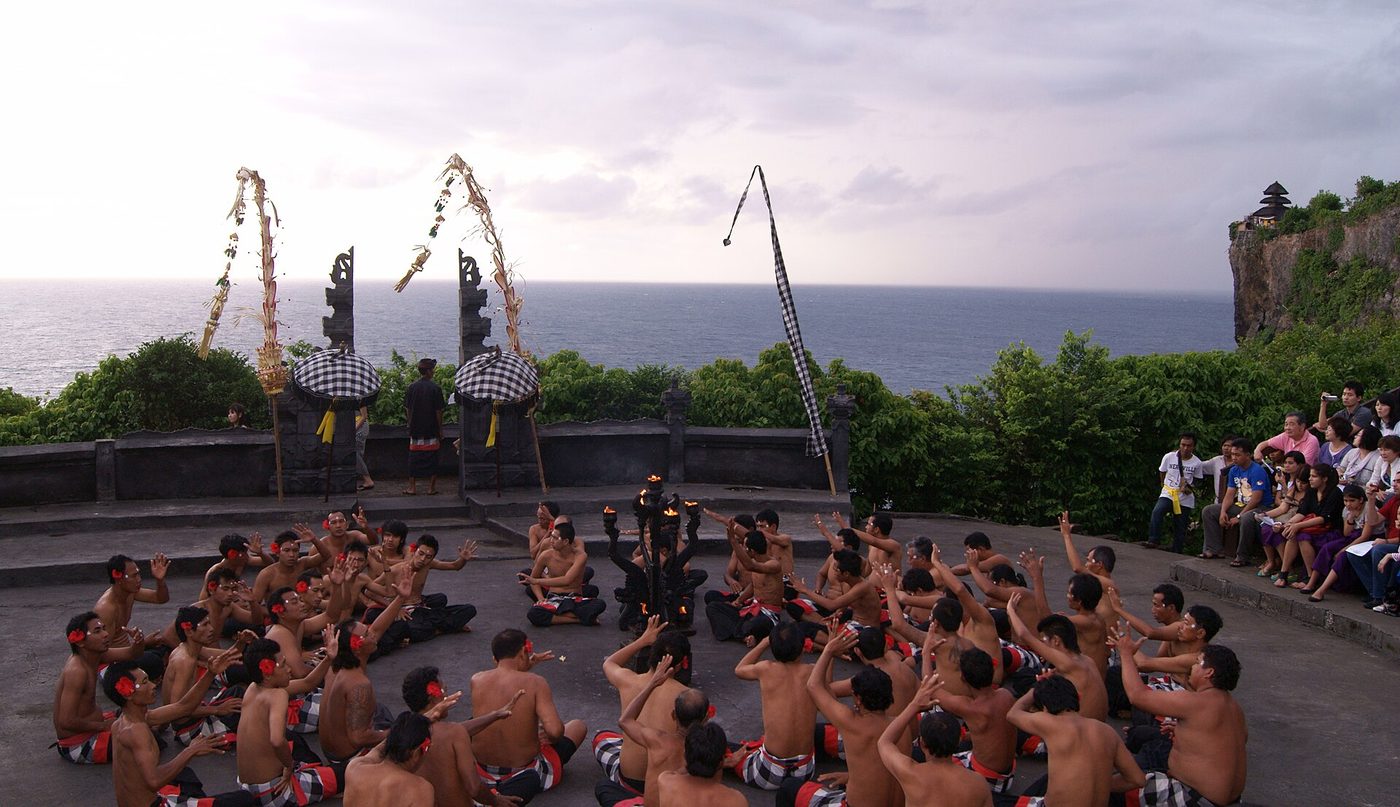 The kecak chorus at the cliff-top amphitheatre of Pura Luhur Uluwatu. Photo: Midori / Wikimedia Commons (CC BY 3.0)

Times and prices are set by each venue and they change, so check with the venue before you go.
In north Bali. No regular kecak stage in Buleleng turned up in our research, and the Ministry's list is all in the south. Kecak does come north for festivals: at the Lovina Festival in July 2023, children from the waste-bank community of Kalibukbuk performed kecak on Binaria Beach, and the regency's culture office filmed it. The festival's current programme is in the Lovina Festival guide, and the north's own traditions, from gong kebyar to the masked Wayang Wong of Tejakula, are in north Bali's dance and music.
From Lovina, Uluwatu and Ubud are a long drive across the island, so an evening kecak works best on a night spent in the south; Palm Living runs day tours from Lovina, including one to Ubud, and its villas are around Lovina for the north end of the trip.
Watching Kecak Respectfully
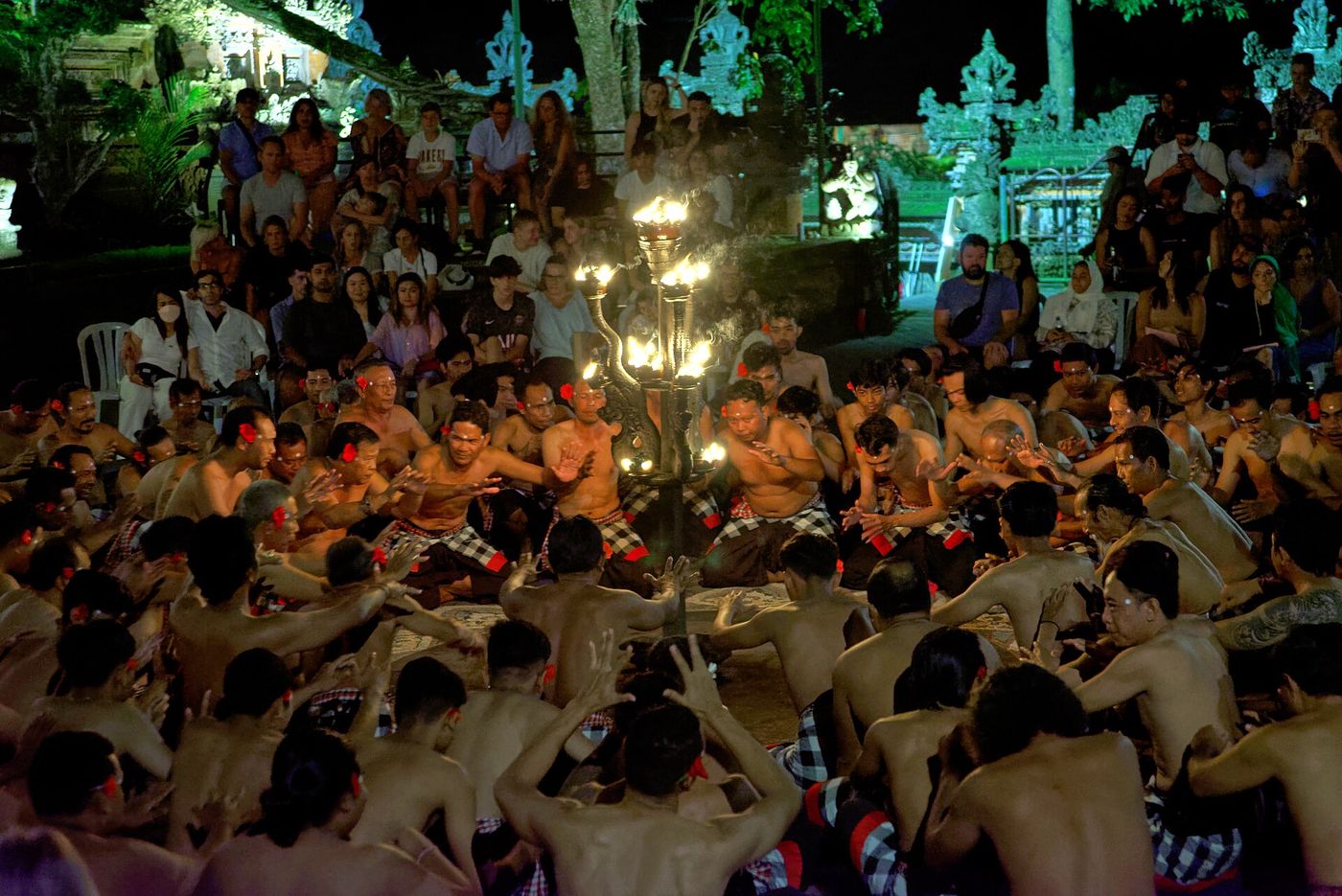 Kecak on the open stage of Pura Dalem, Ubud, with the audience close behind the chorus. Photo: Jakub Hałun / Wikimedia Commons (CC BY-SA 4.0)

- Uluwatu and Pura Dalem are temples. Wear a sarong and sash, cover your shoulders, and follow the rules in Bali temple etiquette.
- Arrive early and dress modestly, as the Ministry of Tourism advises.
- Stay out of the circle. The chorus and the lamp are the stage; do not cross it for a photograph.
- Turn off the flash and keep your phone low for the people behind you.
- At Uluwatu, hold on to your things. The temple's monkeys take sunglasses and phones, as the best temples in Bali warns.
- If you meet sanghyang at a village ceremony, you are at a sacred rite. Stay at the back and follow the lead of the villagers; Balinese ceremonies explains the setting.
FAQ
What is the kecak dance? Kecak is a Balinese dance-drama performed to the chanting of a male chorus instead of a gamelan. The men sit in rings and call "cak" in interlocking rhythms while dancers in the centre act out an episode of the Ramayana.
What is the story behind the kecak dance? The Ramayana: Sita is abducted by Rahwana, and Rama fights to rescue her with the help of Hanuman and the monkey army. Performances often include Hanuman burning Rahwana's kingdom, and some add the fight of the monkey kings Subali and Sugriwa.
Who created the kecak dance? It grew from the chorus of the sanghyang trance ritual. In the early 1930s the dancer I Wayan Limbak, the villagers of Bedulu and the German painter Walter Spies shaped it into a staged Ramayana drama, and Limbak's touring troupes made it famous abroad.
What does kecak mean in English? The name comes from "cak", the call the chorus repeats, so the word is the sound itself. In English kecak is often called the Ramayana monkey chant, and old Dutch museum captions call it the apendans, the monkey dance.
Is kecak a religious dance? Its roots are religious, in the sanghyang trance ritual, but kecak itself is classed as an entertainment dance, one of the balih-balihan. Many venues are temples, so dress and behave as you would at one.
Where is the best place to watch kecak in Bali? The best-known performance is at Uluwatu Temple at sunset. Ubud's Pura Dalem Taman Kaja offers a more intimate village performance, and the Ministry of Tourism also lists Garuda Wisnu Kencana, Melasti Beach and Tanah Lot.
Can you see kecak in north Bali? Not on a regular stage. Kecak appears in the north at festivals, such as the Lovina Festival, and the sanghyang tradition it came from survives in the Bali Aga villages of Buleleng as a sacred rite.
Sources
- Kendra Stepputat, The Genesis of a Dance-Genre: Walter Spies and the Kecak (2010), for the sanghyang rite, the film, the damar kecak and the parts of the chorus, read September 2026 (in English)
- UNESCO Intangible Cultural Heritage, Three genres of traditional dance in Bali and the nomination file, for Sanghyang Dedari and kecak's place among the entertainment dances, read September 2026 (in English)
- Indonesia Ministry of Tourism, Kecak Dance: the meaning and its philosophical movements, for the story, the movement and the five places to watch, read September 2026 (in English)
- The Jakarta Post, Limbak, Rina: two generations of kecak dancers, 18 May 2002, archived copy, read September 2026 (in English)
- Los Angeles Times, Wayan Limbak, 106; co-creator of Balinese monkey dance, 8 September 2003, read September 2026 (in English)
- Asian Review of Books, Letter from Bali: films of the 1930s, for Spies and Island of Demons, read September 2026 (in English)
- Buleleng Culture and Tourism Office, kecak at the Lovina Festival on Binaria Beach, July 2023, and the maestros behind popular Balinese dances, read September 2026 (in Indonesian)
- Buleleng Research and Innovation Agency, Sacred dances of the Bali Aga villages of Buleleng, read September 2026 (in Indonesian)
- Wikipedia, Kecak, for the name "Ramayana monkey chant", and the Tropenmuseum's photograph captions on Wikimedia Commons, such as De Kecak of apendans, read September 2026 (in English and Dutch)
- Tribun Bali, Kecak Luh, the women of Ubud, July 2017, read September 2026 (in Indonesian)

Read next: the Barong, Bali's guardian spirit, Legong, the court dance and Rejang, Bali's sacred offering dance.