
On this page
In Brief
The Barong is Bali's guardian spirit, a mythical beast danced by two men inside one costume. The Balinese identify it with Banaspati Raja, the protector of the forest, a power that Balinese scholars connect with Siwa. Its opposite is Rangda, the widow-witch linked to Durga and to the old story of Calonarang, and their meeting on stage is one of Bali's best-known pictures of good and evil held in balance. The common form is the lion-like Barong Ket, but there are boar, tiger, elephant, dog and giant human forms too. A village Barong is consecrated and kept in a temple, and appears at ceremonies and at Galungan; the Barong and Kris dance sold to visitors is a stage version of the same story. When UNESCO inscribed Balinese dance in 2015, Barong Ket was one of the nine dances chosen to represent it.
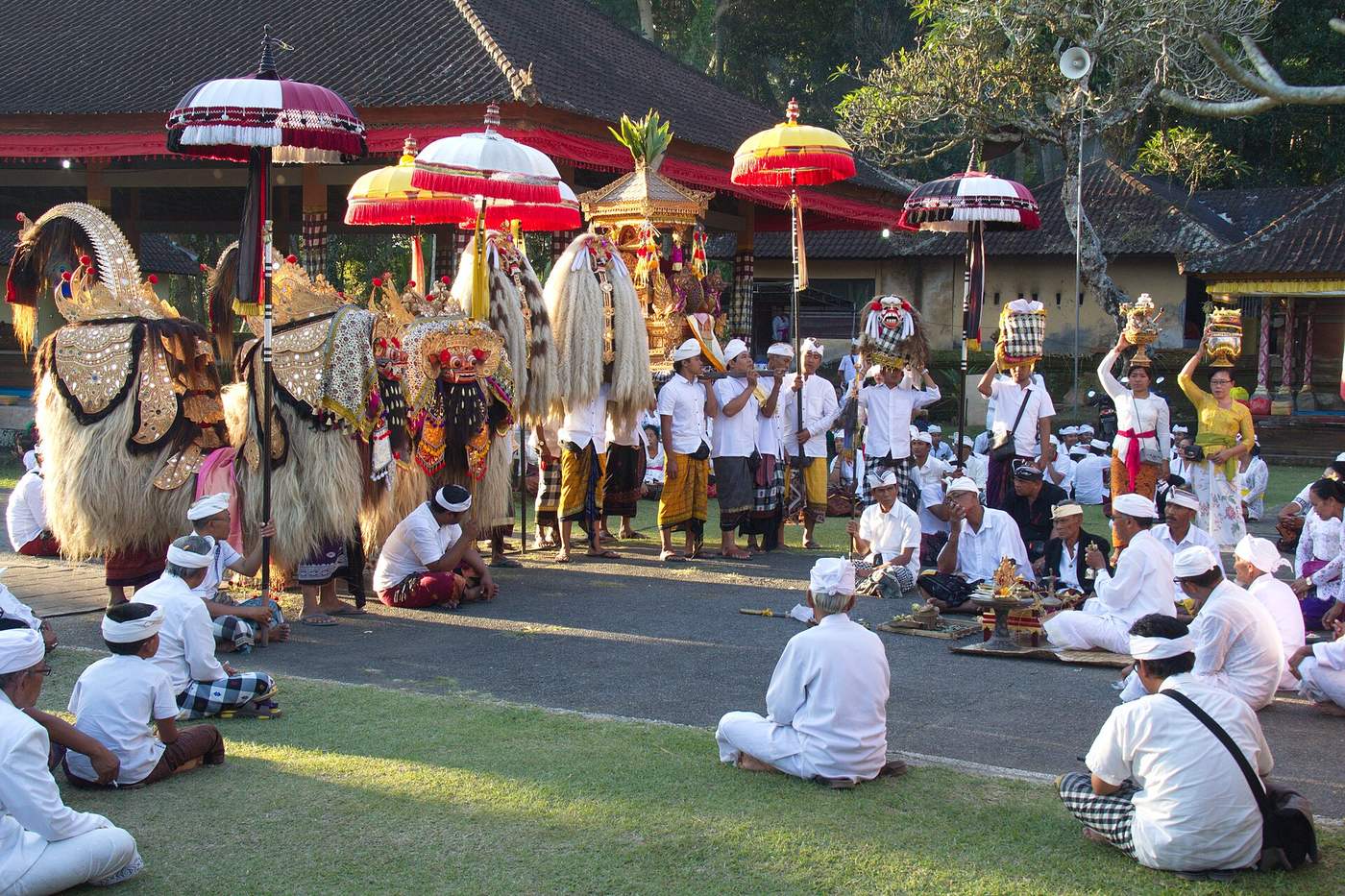 Barong Ket figures blessed at a temple ceremony, Pura Penguku-Ukuran, Pejeng. Photo: Alain Secretan / Wikimedia Commons (CC BY-SA 4.0)
The Barong at a Glance
- What it is: A protective spirit, embodied in a masked costume carried and danced by two men
- Who it is: Banaspati Raja, protector of the forest and one of a person's four spirit siblings
- Most common form: Barong Ket, the lion-like beast with a red mask, white fur and mirrored gold ornaments
- Its opponent: Rangda, the widow-witch, identified with the goddess Durga
- The story behind the drama: Calonarang, the widow of Girah whose magic brought plague
- Where it lives: Kept in a village temple, brought out for ceremonies and for Galungan and Kuningan
- UNESCO: Barong Ket is one of the nine dances in Three genres of traditional dance in Bali, inscribed 2015
- In the north: Rare, and all the more interesting for it; Tukadmungga at the eastern end of Lovina keeps a temple Barong that walks the village at Galungan
What the Barong Is
Indonesia's Ministry of Tourism calls the Barong the king of the spirits, a guardian who stands for virtue, and describes the Barong Ket as a lion-like figure covered in thick white fur and adorned with gold and pieces of mirror, danced by two people moving as one (Indonesia Travel). The ministry also says the Barong dance, like the sanghyang trance dances, belongs to Balinese culture older than Hinduism on the island.
The Buleleng culture office gives the Balinese reading. Every person is accompanied through life by four spirit siblings, the catur sanak, and one of them is Banaspatiraja, the spirit believed to give a Barong its taksu, its charged, protective power (Buleleng Culture and Tourism Office). A 2019 study in the ISI Denpasar arts journal Mudra defines the Barong as the form of Banaspati Raja, a magical beast that is Siwa's manifestation when he destroys disease and danger (Wirawan, Mudra).
The same study describes how a temple Barong is made. The mask is carved from the wood of a living tree, often pule, cut on an auspicious day after asking permission of the tree's spirit. The carver is himself a priest. The body is a frame of split bamboo and rattan, dressed in hair and fibre, with nine peacock feathers and a small bell in the tail.
Barong Ket and the Other Forms
Each region of Bali has its own protective spirit, and the Barong takes a different animal form from place to place (Indonesia Travel). The Mudra study lists fifteen. These are the ones you are most likely to meet:
- Barong Ket (also Barong Ketet): the lion-like Banaspati Raja, found all over Bali and almost always paired with a Rangda.
- Barong Bangkal or Bangkung: a boar. In Balinese bangkal is a male pig and bangkung a sow, and children often carry it through the village at Galungan (Buleleng Culture and Tourism Office).
- Barong Macan: a tiger, tied to the animal fables of the Tantri, kept in only a few villages.
- Barong Landung: two tall human figures, a dark-faced man, Jero Gede, and a pale woman, Jero Luh. The Buleleng office links them to the cult of the Balinese king Jayapangus and his Chinese wife, Kang Ceng Wie.
- Barong Asu, Gajah and Sampi: a dog, an elephant and a cow, walked through their villages at Galungan and Kuningan.
- Barong Brutuk: found only in Trunyan, on Lake Batur, with a costume of dried banana leaves.
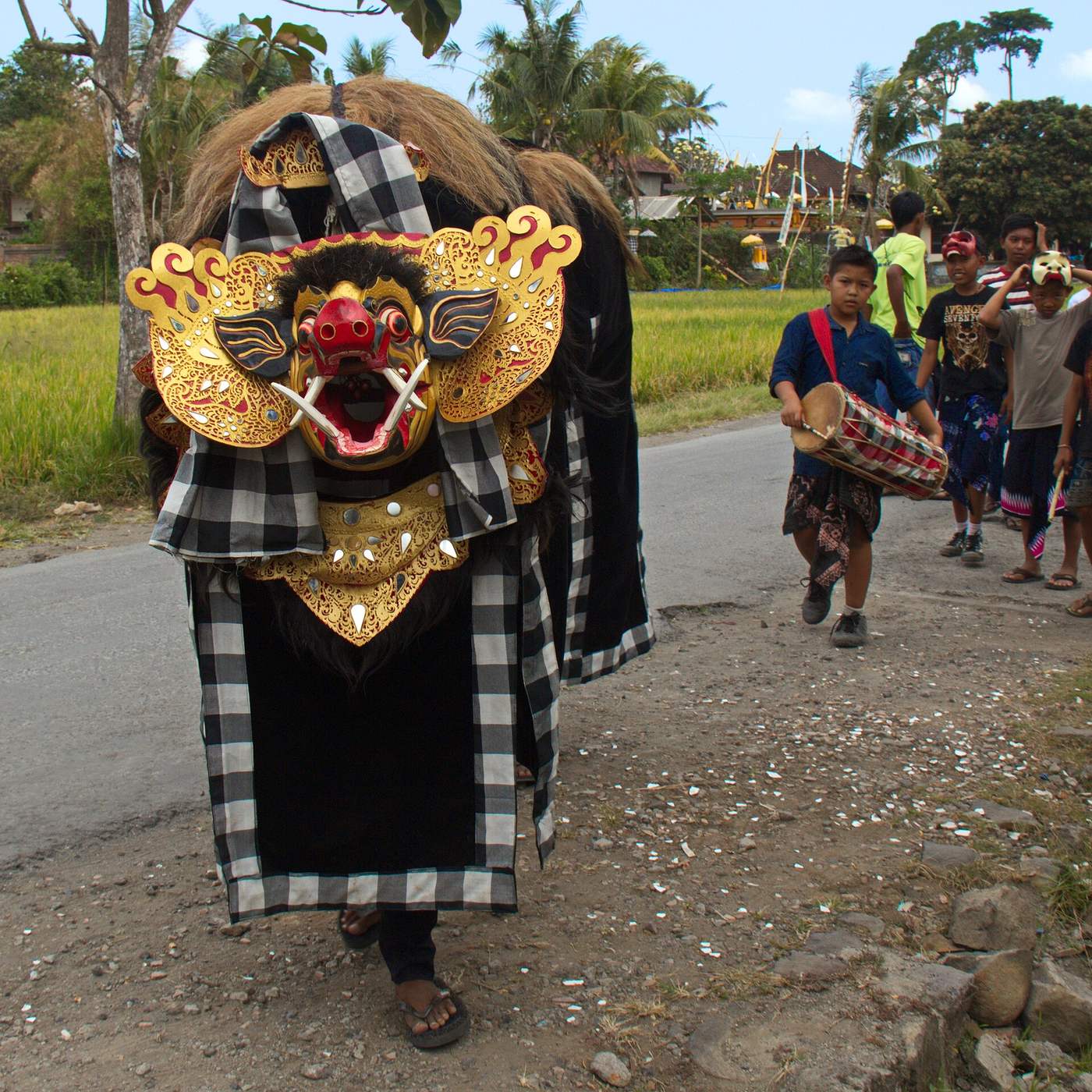 A Barong Bangkal walking a village road in Tabanan, with its drummer behind. Photo: Alain Secretan / Wikimedia Commons (CC BY-SA 4.0)

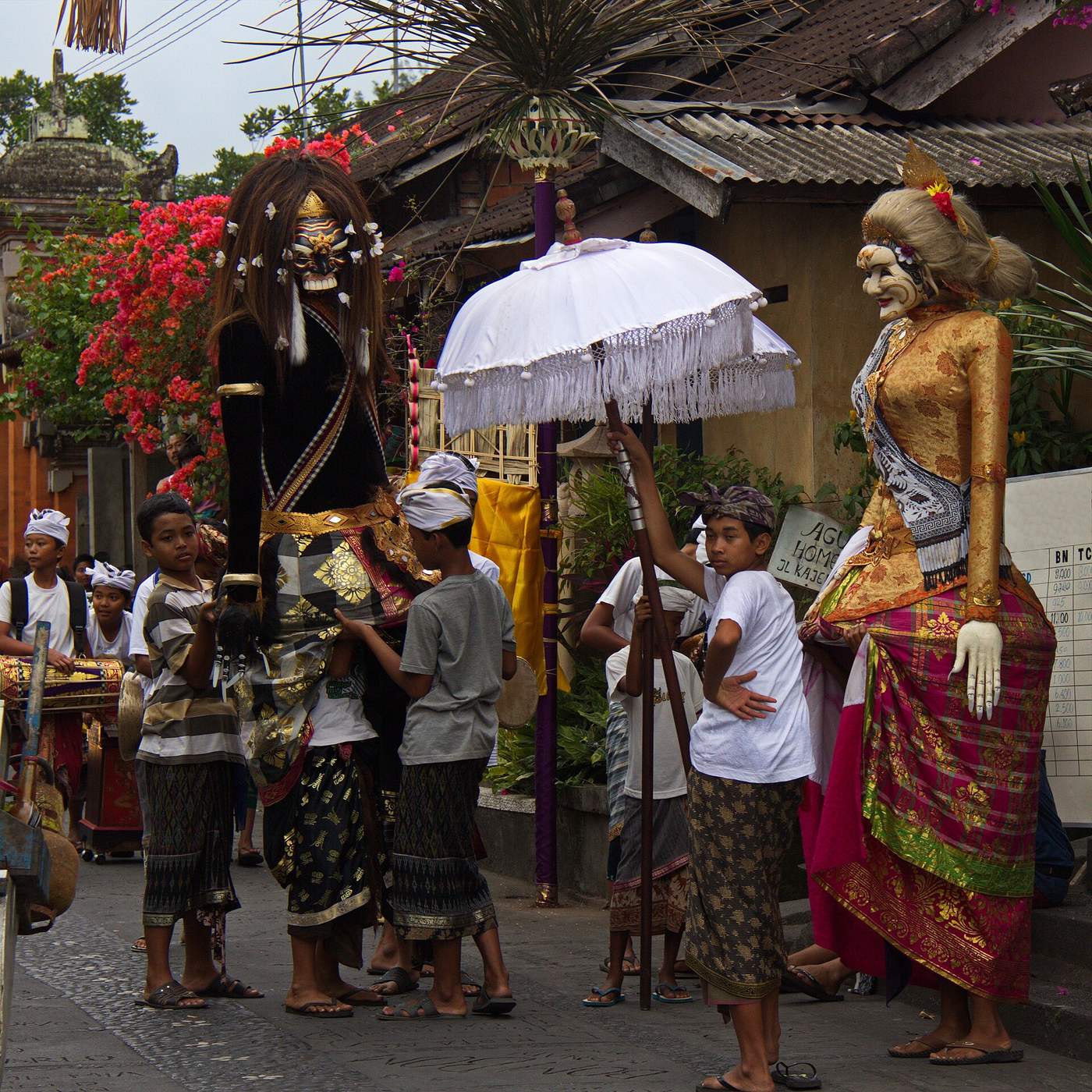 Barong Landung, Jero Gede and Jero Luh, on a street in Ubud. Photo: Alain Secretan / Wikimedia Commons (CC BY-SA 4.0)

Rangda and the Calonarang Story
Rangda means "widow". In the belief of Balinese Hindus she is the earthly form of the goddess Durga and the ruler of the graveyard, and in the old palm-leaf text of Calonarang she is the widow of Girah (Wirawan, Mudra). Temples that keep a Rangda may have a white-masked Ratu Ayu, a red-masked Ratu Mas, or both.
The Calonarang story is set in Girah, in the Javanese kingdom of Kediri. The widow Calon Arang is a master of black magic. Because people fear her, no man will marry her daughter, Ratna Manggali, and in her fury she calls on Durga. Flood and plague follow. King Airlangga's soldiers fail against her, so his adviser, the sage Mpu Bharadah, sends his pupil Mpu Bahula to marry the daughter. Bahula steals the widow's book of spells, and without it she is defeated (Wikipedia).
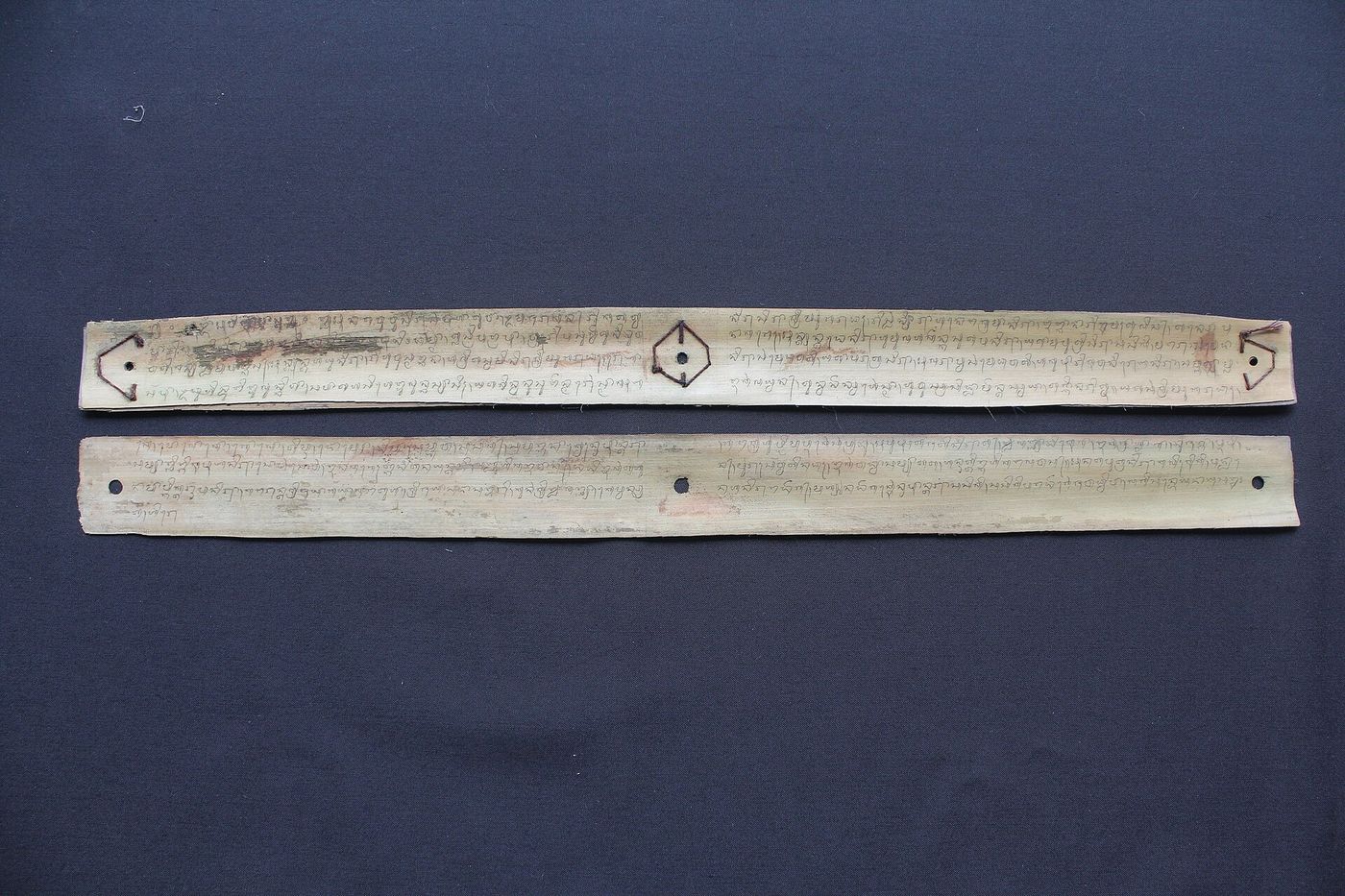 Two leaves of a Calonarang manuscript on palm leaf, kept in the village of Tojan. Photo: Eka343 / Wikimedia Commons (CC BY-SA 4.0)

Performed as sacred drama, Calonarang happens at night, and parts of it may take place in the cemetery. The widow first appears as Matah Gede with her female disciples, the sisya, and transforms into Rangda. The Barong and Rangda costumes are prepared with offerings so that their chosen dancers, the penyungsung, can be possessed, and men called patih attack Rangda with their kris. A lay priest makes offerings before the performance, and afterwards the two figures are returned to their place in the temple (Suryanegara, Revue musicale OICRM). In the Ministry of Tourism's words, the Barong defeats Rangda, restoring balance in nature. Keeping the two forces in balance is the idea the Balinese call rwa bhineda.
The Barong in the Temple
Not every village or temple keeps a Barong and Rangda, and where one does, the figure is a tapakan, a seat for the deity (Wirawan, Mudra). A newly made Barong is only a "barong-barongan", an imitation, until it has been purified at the sea, consecrated, and brought to life in the ngereh ceremony at the graveyard. From then on it is treated as holy.
The time most people see a village Barong is Galungan and Kuningan, the ten days when the ancestors are believed to return (see Galungan and Kuningan). In the custom called ngelawang, from lawang, a door, the Barong is paraded from house to house to the gamelan called batel bebarongan, often by children and teenagers of the village arts club, to turn away misfortune and drive off harmful spirits (Buleleng Culture and Tourism Office). Households wait at the gate with an offering; Balinese offerings explained covers what goes into one.
UNESCO's inscription file for Balinese dance chose Barong Ket "Kuntisraya", with a studio from the village of Kapal in Badung as its example, to represent the entertainment genre (nomination file). It also notes that even when these dances are staged for tourists, the purification ritual for dancers and musicians is still performed before they begin. For how the sacred and staged dances fit together, see Balinese dance and music.
The Barong and Kris Dance on Stage
The Barong and Kris dance is the staged version. In the Ministry of Tourism's account, men with kris daggers fight, then turn the blades on themselves in trance when the Barong appears, and after the Barong defeats Rangda they are brought round with a sprinkle of holy water. Wikipedia's summary adds that the Barong's magic makes the entranced men invulnerable, and describes the opening, in which two monkeys tease the Barong (Barong dance).
The ministry names the best-known regular performances as those of the Batubulan villagers in Gianyar and at Kesiman in Denpasar. Check times with the venue on the day.
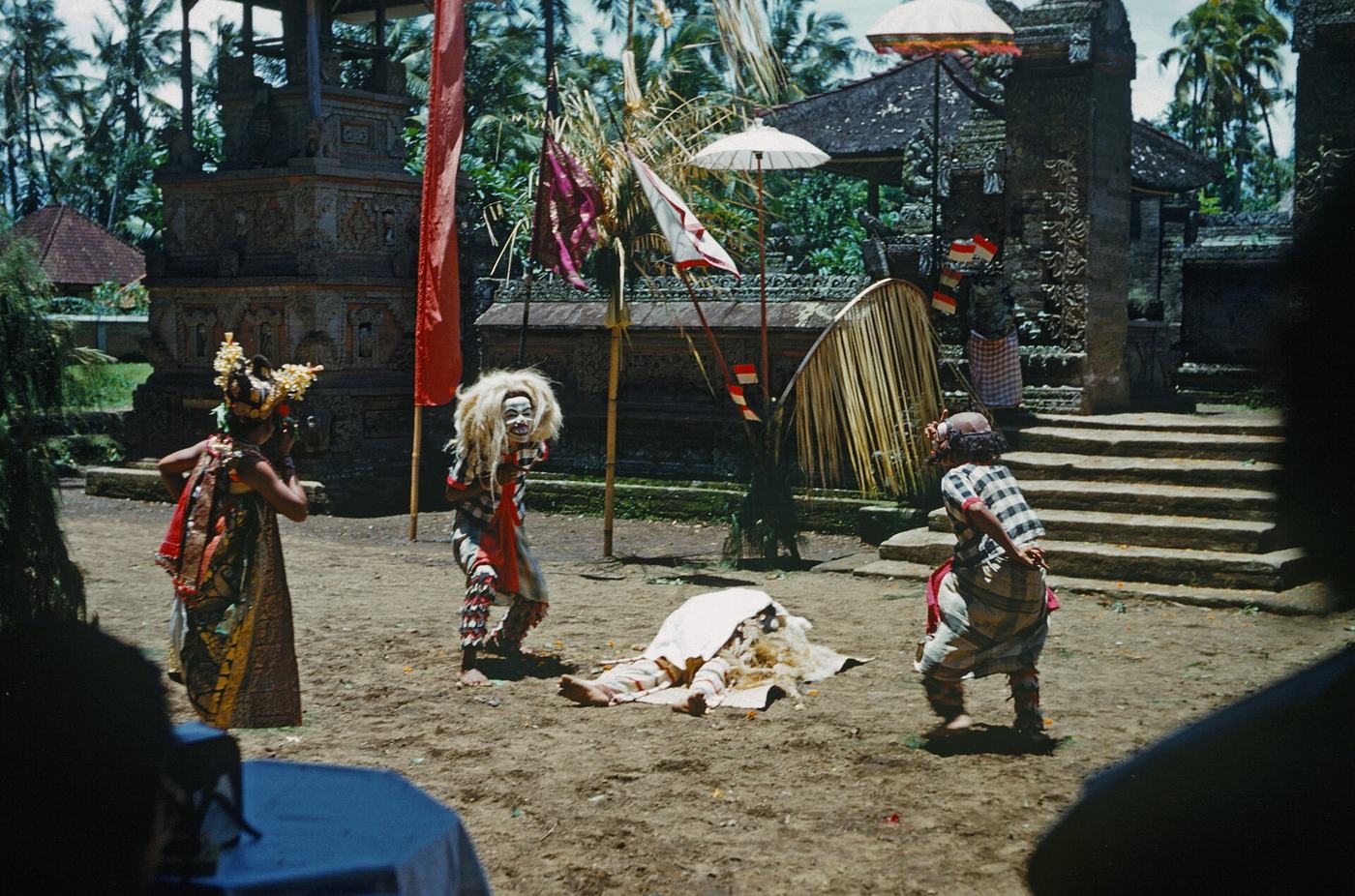 A kris and Barong dance in a temple forecourt, photographed in February 1962. Photo: Don Christie / Wikimedia Commons (CC BY-SA 4.0)

The Barong in North Bali
The north has fewer Barongs than the south, and Buleleng's own culture office says so plainly. Barong traditions are not widely found in north Bali; where they exist, in places such as Pemaron and Tejakula, they are rare exceptions, and the Barong dances staged at the Buleleng Festival from 2014 to 2016 followed the south's model (Buleleng Culture and Tourism Office). The Mudra study lists one form, the Barong Singa, as found only in Buleleng, where it serves to ward off calamity.
Tukadmungga, Lovina. At the eastern end of the Lovina strip, Tukadmungga's Barong comes down from the Pura Desa on penampahan, the day before Galungan, and visits every house in the village. Families put an offering of flowers, incense and a little money at the gate, and a dancer walking with the Barong collects the money. The purpose, the culture office explains, is to honour the lower spirits so they do not disturb the holy days, and to ask safety for the whole village (Buleleng Culture and Tourism Office). Pemaron, the next village, is one of the exceptions the office names.
Banyuatis and Umejero, in the hills. In July 2025 Sanggar Tri Bhuwana Giri of Banyuatis entered the Barong Ket competition at the Bali Arts Festival, which Buleleng had long sat out. Its Barong was danced to north Bali gong kebyar, fast and sharply accented, and the studio's mentor, Gede Yudi Gautama, described the sacred figure Banyuatis worships as Ratu Gede as part of the calling (Buleleng Regency). In June 2026 the regency was represented by Sanggar Seni Wahana Santhi of Umejero with "Singa De Barong" (Buleleng Regency).
On the beach. The Lovina Sunday Market opened in July 2025 with a Barong and Rangda dance on the sand, and the Barong is part of the traditional programme at the Lovina Festival.
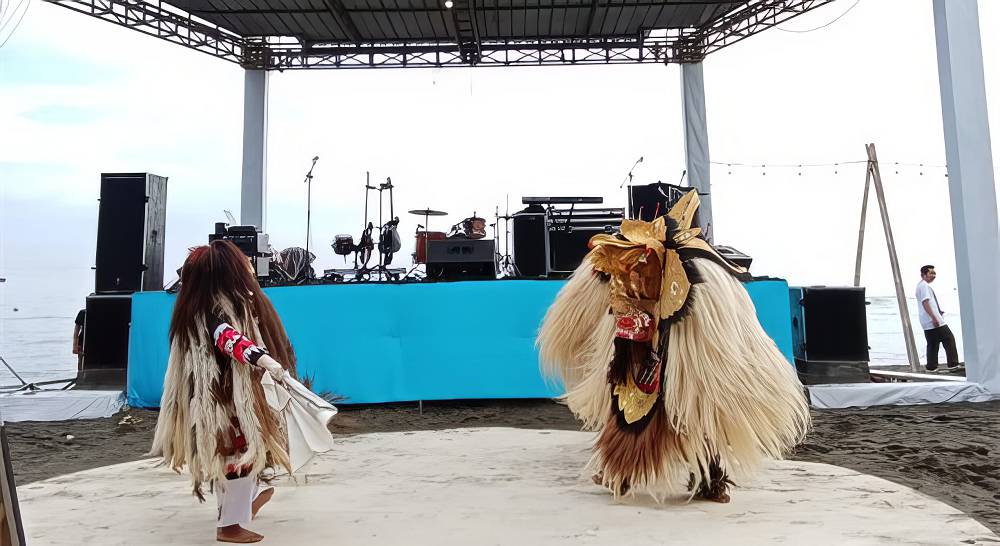 The Barong meets Rangda on the sand at the market's opening. Photo: Palm Living.
Palm Living's villas are mostly around Lovina, a short drive from Tukadmungga and Pemaron, and its own guide to the Barong suggests asking the staff whether a dance is on nearby.
Watching a Barong Respectfully
- At a ceremony, wear temple dress, a sarong and sash, and keep to the outer courtyard unless you are invited in. Bali temple etiquette has the full rules.
- Do not touch the Barong or Rangda. A consecrated one is a sacred figure, whatever it looks like at a street parade.
- During ngelawang, stand to the side and leave the gateway to the household making the offering.
- In the kris scenes keep well back, and let the priests and helpers do their work.
- Ask before photographing people at a ceremony, and turn off the flash.
FAQ
What is the Barong in Bali? The Barong is a protective spirit, the king of the spirits in Balinese belief, embodied in a large masked costume danced by two men. The Balinese identify it with Banaspati Raja, a guardian power, and a village keeps its Barong in a temple as a sacred figure.
What does the Barong represent? Goodness and protection. It stands against Rangda, the widow-witch who represents destructive magic, and their fight shows the Balinese idea of keeping good and evil in balance.
What is the difference between Barong and Rangda? The Barong is a four-legged guardian beast, most often lion-like; Rangda is a fanged, long-haired widow-witch identified with the goddess Durga and the graveyard. Temples that keep one usually keep the other, and in the Calonarang drama they meet.
Is the Barong dance sacred? Both, depending on where you see it. A consecrated village Barong at a ceremony or at Galungan is sacred. The Barong and Kris dance performed for visitors is a staged version, though UNESCO's nomination file notes that the dancers and musicians still go through a purification ritual first.
What are the types of Barong? Barong Ket, the lion-like form, is the most common. Others include Barong Bangkal (a boar), Barong Macan (a tiger), Barong Landung (two tall human figures), Barong Asu (a dog), Barong Gajah (an elephant) and Barong Brutuk, found only in Trunyan.
Where can I see a Barong in north Bali? The Barong is rarer in the north. On the eve of Galungan, Tukadmungga in Lovina walks its temple Barong from house to house, and the Barong appears on stage at the Lovina Festival and at regency events. Ask your host whether anything is on during your stay.
Sources
- UNESCO Intangible Cultural Heritage, Three genres of traditional dance in Bali and the nomination file, for the nine dances, the Barong Ket of Kapal and purification before tourist shows, read September 2026 (in English)
- Indonesia Ministry of Tourism, The Barong and the Kris Dance, for the Barong's appearance, its regional forms, the Calonarang ending and where the dance is performed, read September 2026 (in English)
- Komang Indra Wirawan, Liturgi Sakralisasi Barong-Rangda, Mudra 34:3 (2019), ISI Denpasar, for Banaspati Raja, Rangda and Durga, the forms of Barong, how a Barong is made and consecrated, read September 2026 (in Indonesian)
- I Putu Arya Deva Suryanegara, Trance and Dance in Bali (1951), Revue musicale OICRM 9:1 (2022), for how a sacred Calonarang is performed, read September 2026 (in English)
- Buleleng Culture and Tourism Office, Barong, the ngelawang tradition of Tukadmungga and ngelawang and Barong Bangkung, read September 2026 (in Indonesian)
- Buleleng Regency, Barong Ket Buleleng at the Bali Arts Festival, July 2025, and Buleleng's manpower and energy office, Barong Ket as a symbol of harmony, June 2026, read September 2026 (in Indonesian)
- Wikipedia, Calon Arang, Barong (mythology) and Barong dance, for the Calonarang story and the order of the staged dance, read September 2026 (in English)
- Palm Living, Balinese Barong Dance on Bali Information, read September 2026 (in English)
Read next: Balinese Hinduism explained, Balinese ceremonies and Rejang, Bali's sacred offering dance.