
On this page
In Brief
Panyembrama dance is Bali's welcome dance, performed to greet guests, usually as the first dance of an event. Its name comes from the Balinese word sambrama, welcome.
The choreographer I Wayan Beratha created it, and it was first performed at the Pandan Festival in 1971. He built it from movements of older dances, among them legong, condong and pendet. It gave Bali a secular welcome dance at a time when greeting outsiders with sacred dances had become contested.
Young women dance it with bowls of flowers and incense. They begin kneeling, as if in prayer, and end by scattering petals over each other and the audience. In north Bali it has opened both the Buleleng Festival and the Lovina Festival as a mass dance.
Panyembrama at a Glance
- What it is: A Balinese welcome dance for guests, made to be danced outside the temple
- The name: From the Balinese sambrama, welcome
- Created: 1971, first performed at the Pandan Festival
- Choreographer: I Wayan Beratha (1926 to 2014), per The Jakarta Post and Wikipedia. Detik Bali credits I Nyoman Kaler
- Built from: Movements of legong, condong and pendet
- Dancers: Young women, two or more, each carrying a bowl of flowers and incense
- The ending: Petals scattered over the dancers and the audience
- No story: It welcomes and does not tell a tale
- In north Bali: A mass opening dance at the Buleleng Festival and the Lovina Festival
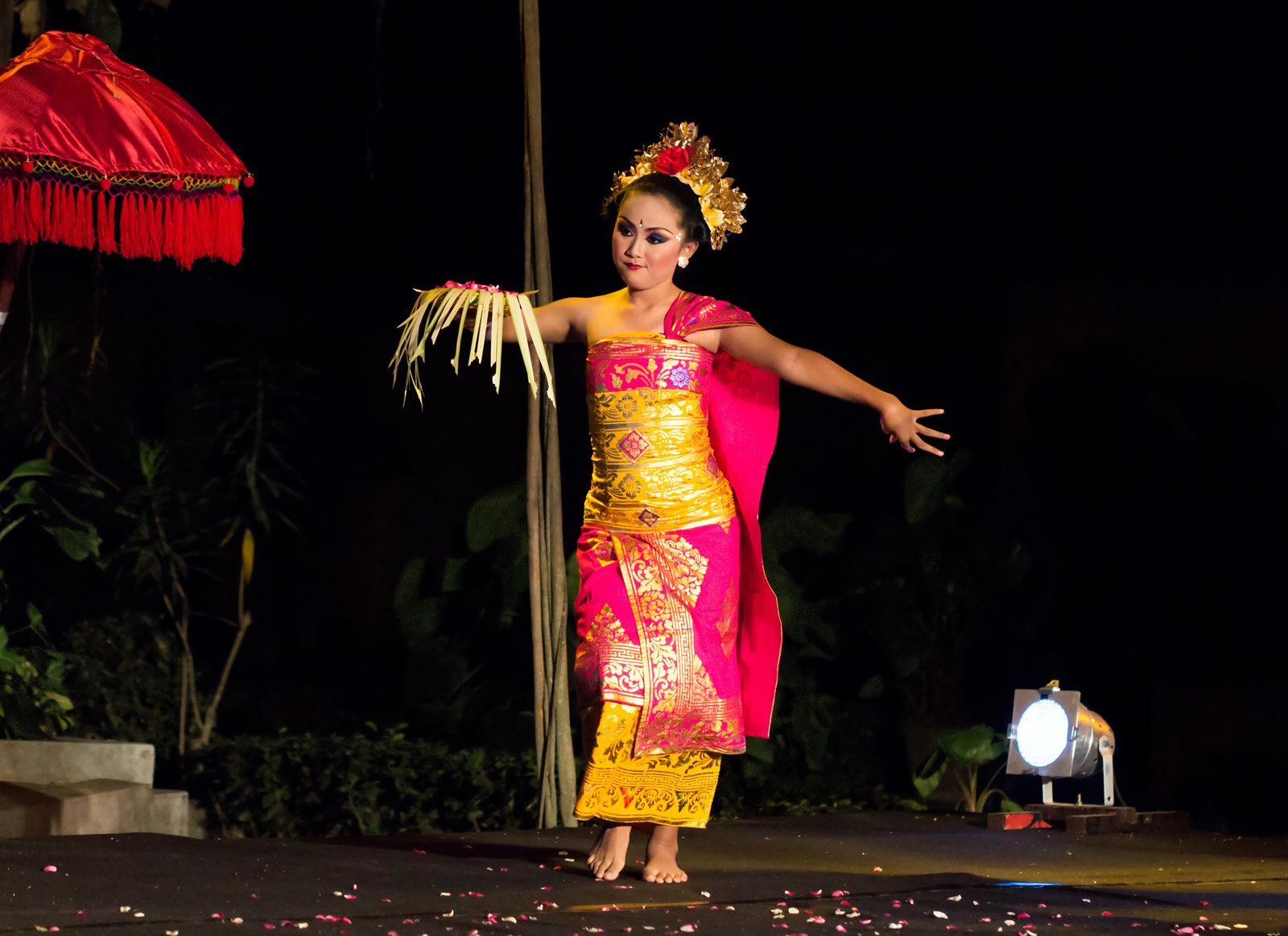 A Panyembrama dancer of Sekar Jepun, the Balinese dance troupe of Sanata Dharma University in Yogyakarta, at its 17th anniversary in 2014. Photo: Chris Woodrich (Crisco 1492) / Wikimedia Commons (CC BY-SA 4.0)
Panyembrama Was Made So Sacred Dances Could Stay in the Temple
Panyembrama exists because Bali needed a welcome dance that was not sacred.
Pendet began as a temple dance. UNESCO's nomination file for Balinese dance lists Pendet Upacara among the sacred wali dances, performed in the temple's inner courtyard. In the 1950s I Wayan Rindi and Ni Ketut Reneng set it as a welcome dance for four, performed in tourism shows at hotels in Denpasar (Wikipedia). Beratha later reworked it with Rindi, as The Jakarta Post recorded. That welcome Pendet, and its mass performance at the 1962 Asian Games, are told in north Bali's dance and music guide.
By the late 1960s, using sacred dances to welcome non-Balinese guests had become a point of controversy. Wikipedia's article on the dance summarises the scholars on what followed. A secular dance was needed for use outside the temples, so the original dances could keep their sacredness.
The task went to I Wayan Beratha, a choreographer at the Konservatori Karawitan (Kokar), the performing arts conservatory. Beratha combined the most beautiful movements of legong, condong and pendet. Condong is the attendant role in the legong.
The new dance was first performed at the Pandan Festival in 1971, according to a 2012 report in The Jakarta Post.
The man behind it
Beratha was born in Banjar Belaluan, Denpasar, on 14 February 1926, and died in Denpasar on 10 May 2014 (Kompas). Kompas credits him with a hand in founding Kokar, the dance academy ASTI and the arts university ISI. His obituary in The Jakarta Post lists his Ramayana dance drama of 1965 and the Manukrawa dance among his other works.
One source names a different choreographer
Detik Bali credits the choreography to the dance master I Nyoman Kaler, with the music by Beratha. The Jakarta Post, in 2012 and again in 2014, credits the dance to Beratha.
What Happens in a Panyembrama
A Panyembrama usually comes first.
In long programmes it is danced before a secular legong. The dancers, young women, come on carrying a metal bowl of flowers and incense. Detik Bali names the bowl a bokor and lists a canang, the small palm-leaf offering, among the dancers' props.
The costume is layered cloth with prada, a pattern in gold leaf. A kamben wraps the body, and a tight band of cloth runs from chest to waist. Golden headdresses and frangipani flowers crown the dancers.
The dance runs in a clear order:
-
The dancers enter walking, the bowl of flowers in the right hand.
-
They kneel, as if praying.
-
They make slow welcoming movements toward the guests, to gamelan.
-
To finish, they move in circles and throw flowers over each other and the audience.
Panyembrama tells no story, unlike some Balinese dances. Its whole subject is the welcome.
The coordinator of the July 2025 Lovina Festival performance, Ida Ayu Ketut Widia Utami, explained its meaning to the Buleleng regency. The dance portrays a graceful, hospitable Balinese girl, like a flower in bloom. Scattering the flowers, she said, means spreading hospitality and peace.
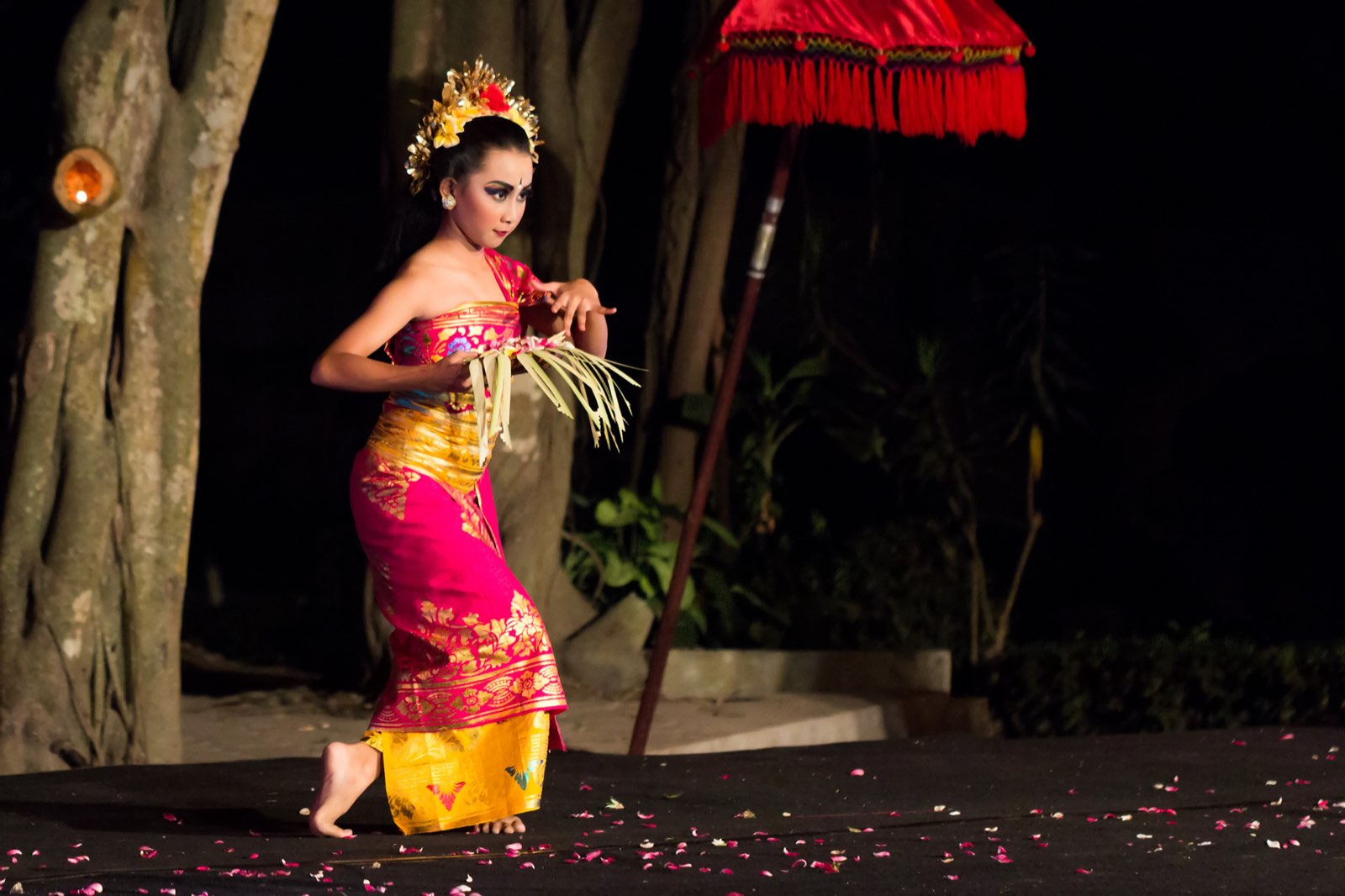 The offering held close in a Panyembrama, danced by Sekar Jepun of Sanata Dharma University, Yogyakarta, in 2014. Photo: Chris Woodrich (Crisco 1492) / Wikimedia Commons (CC BY-SA 4.0)

Panyembrama Sits With the Entertainment Dances
Balinese dance has three genres: sacred wali, ceremonial bebali and balih-balihan for entertainment. They are explained in the guide to Balinese dance.
Welcome dances belong to the third. In 2023 the head of Bali's Hindu council, PHDI Bali, told Antara that the welcome dances staged at hotels count as entertainment, for watching. Sacred dances such as Rejang stay in the temple.
The temple has taken Panyembrama in, too. Wikipedia's sources record it danced at temple ceremonies as a welcome for the gods. The art critic A. M. Hermin Kusmayati classed it as a classical dance, for its roots in the older dances.
Bali has more than one welcome dance
Puspanjali is another. The Jakarta Post's 2012 report describes it as the work of N.L.N. Swasthi Wijaya Bandem and I Nyoman Windha. The Post describes seven dancers welcoming visitors with movements inspired by the sacred rejang. They honour the visitors with flowers, a symbol of a good heart.
Where to See Panyembrama in North Bali
Buleleng has opened its festivals with a mass Panyembrama.
- The Buleleng Festival. In 2019, 500 dancers from Buleleng's nine districts danced it along 300 metres of Jalan Ngurah Rai in Singaraja (Buleleng revenue agency). See the Buleleng Festival guide.
- The Lovina Festival. In July 2025, 612 dancers opened it on Lovina beach at sunset. They came from high schools, government offices, job-training institutes and the villages around Lovina (Buleleng regency). See the Lovina Festival guide.
- Village studios and gamelan clubs. Buleleng's culture office has filmed local groups dancing it, among them a village dance studio of Bungkulan and a women's gong kebyar club.
The music behind it is the gamelan, and the north's own dance traditions are in north Bali's dance and music guide.
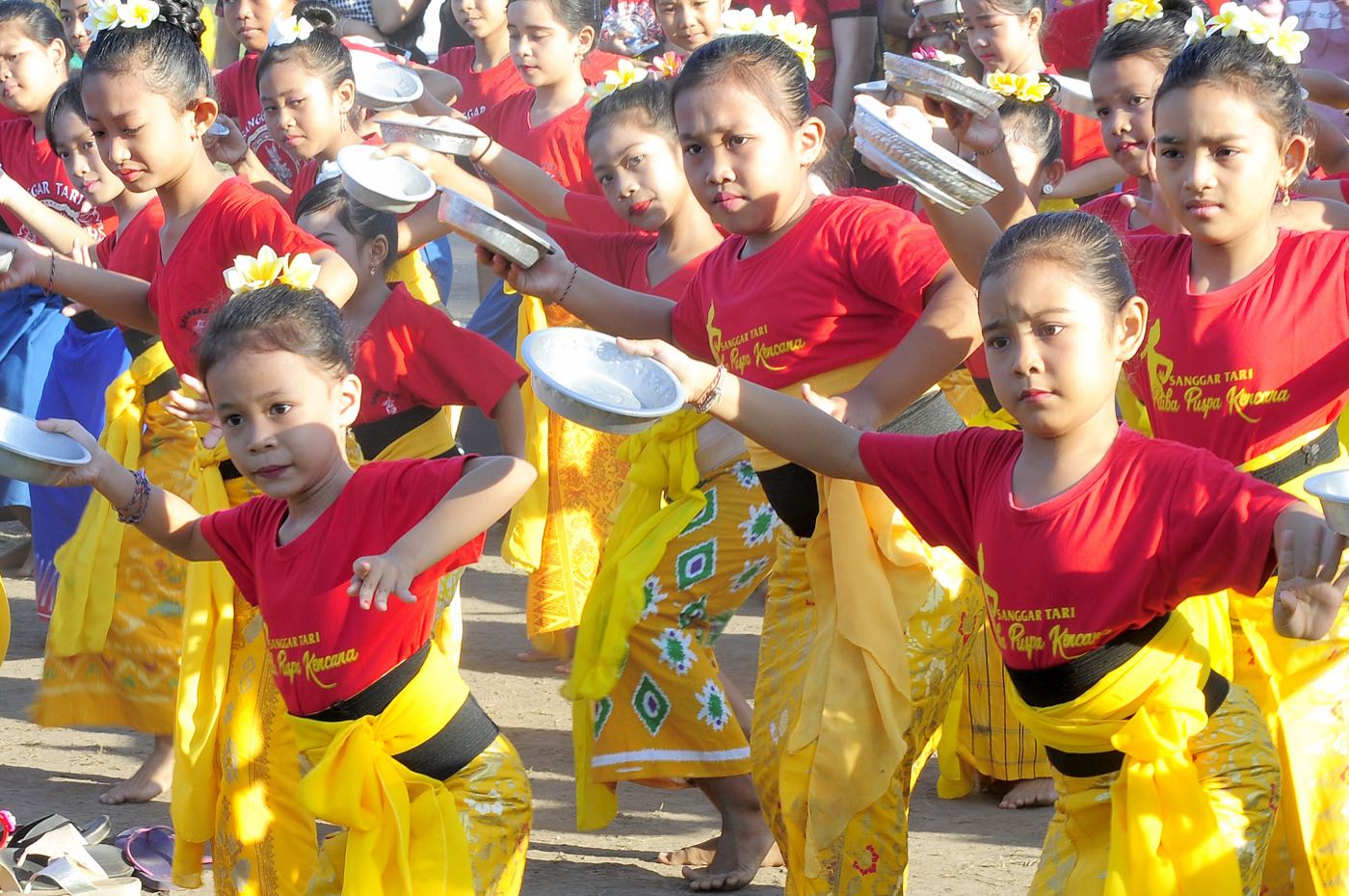 Children from Denpasar's dance studios in a mass Panyembrama at the Denpasar Festival, 2019. Photo: Joni.photo23 / Wikimedia Commons (CC BY-SA 4.0)

Practical Notes
- Festival openings. Check Buleleng's culture and tourism office for each festival's dates and its opening night.
- At a temple. If Panyembrama is part of a ceremony, you are a guest. Wear temple dress and follow Bali temple etiquette.
- The petals. Scattered flowers are the welcome itself. Let them fall.
- Learning it. Wikipedia's sources record that it is taught at Balinese dance schools. Ask at a sanggar, a dance studio, near where you stay.
FAQ
What is the Panyembrama dance? Panyembrama is a Balinese welcome dance for guests, danced by young women carrying bowls of flowers and incense. It was first performed in 1971 and is usually the first dance of an event. It ends with the dancers scattering petals over each other and the audience.
What does panyembrama mean? The name comes from the Balinese word sambrama, which means welcome. The dance's whole purpose is in the name, since it greets guests and tells no story.
Who created the Panyembrama dance? The Jakarta Post and Wikipedia credit the choreographer I Wayan Beratha, who made it in 1971 for the Konservatori Karawitan. Detik Bali credits the choreography to I Nyoman Kaler, with the music by Beratha.
What is the difference between Panyembrama and Pendet? Pendet began as a sacred temple dance, and a welcome version for hotel shows was set in the 1950s. Panyembrama was created in 1971 as a secular welcome dance, so that sacred dances would not be used to greet outsiders. Its movements draw on pendet, legong and condong.
Is Panyembrama a sacred dance? It was made as a secular dance, for use outside the temple. PHDI Bali's head counts hotel welcome dances as entertainment. It has also been danced at temple ceremonies as a welcome for the gods.
What do Panyembrama dancers carry? Each dancer carries a metal bowl, the bokor, filled with flowers and incense. Palm-leaf offerings, canang, are among the props. At the end the flowers are thrown over the dancers and the audience.
Where can I see Panyembrama in north Bali? At the opening of Buleleng's festivals, where it has been danced by 500 dancers in Singaraja and 612 on Lovina beach. Village dance studios and gamelan clubs in Buleleng perform it too.
Sources
- The Jakarta Post, Stories within dances, 7 October 2012: Beratha, the Pandan Festival of 1971, legong keraton and condong, Puspanjali, read October 2026 (in English)
- The Jakarta Post, Bali deeply mourns loss of great maestro Wayan Beratha, 12 May 2014: birth date, Panyembrahma of 1971, Rindi's Pendet and the 1962 rearrangement, other works, read October 2026 (in English)
- Kompas, Lanjut mengenang komponis Wayan Beratha di Bentara Budaya Bali, July 2019: birthplace, death and the schools he helped found, read October 2026 (in Indonesian)
- Wikipedia, Panyembrama, citing Barker, Putra and Wiranatha (2006), Laskewicz (2003), Picard (2006), Heimarck (2003), Kusmayati (1992) and Suardana (2012): the late-1960s controversy, Kokar, the dances it draws on, costume, sequence, temple use and teaching, read October 2026 (in English)
- Wikipedia, Pendet dance: Rindi and Reneng's welcome Pendet of the 1950s for hotel tourism shows, read October 2026 (in English)
- Detik Bali, Tari Panyembrama: sejarah, properti dan gerakannya, October 2022: the bokor and canang, the entrance, the attribution to I Nyoman Kaler, read October 2026 (in Indonesian)
- UNESCO, Nomination file no. 00617, Three genres of traditional dance in Bali: Pendet Upacara among the sacred dances, read October 2026 (in English)
- Antara Bali, PHDI Bali agrees sacred dances are not staged in hotels, June 2023: hotel welcome dances as entertainment, read October 2026 (in Indonesian)
- Buleleng Regency, Mass Panyembrama opens the Lovina Festival 2025: 612 dancers, who they were, the coordinator on its meaning, read October 2026 (in Indonesian)
- Buleleng Regional Revenue Agency, Panyembrama by 500 dancers at the Buleleng Festival 2019: nine districts, Jalan Ngurah Rai, 300 metres, read October 2026 (in Indonesian)
- Buleleng Culture and Tourism Office, videos of Panyembrama by a Bungkulan dance studio and a women's gong kebyar club, read October 2026 (in Indonesian)
Read next: Balinese dance, its three genres and nine UNESCO dances, the legong and the Lovina Festival.